


Published: September 25, 2026
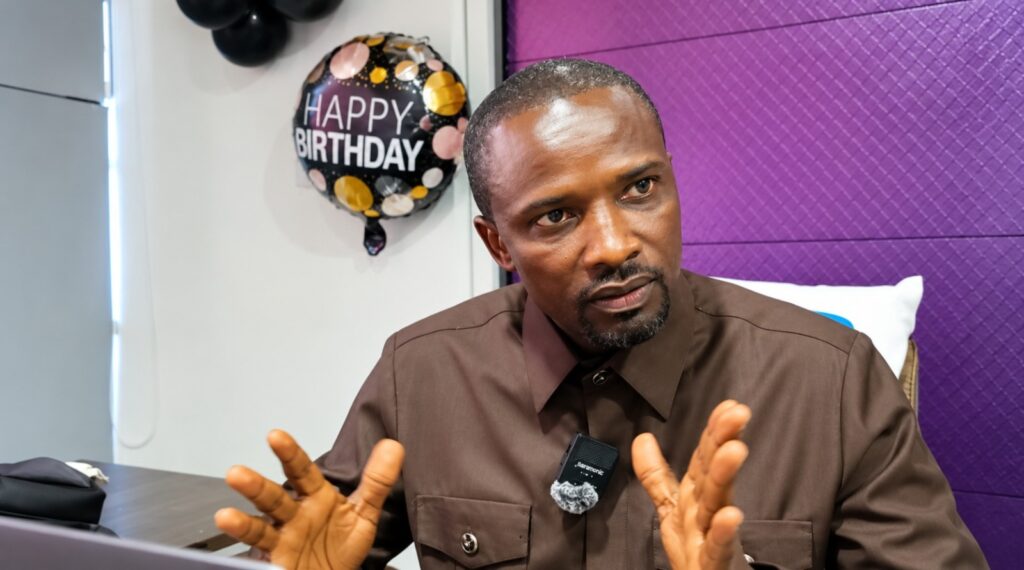
MONROVIA — The Youth Entrepreneurship and Investment Bank Management Company, or YEIBMANCO, is targeting at least 30,000 young Liberians for direct support and another 120,000 indirectly as it rolls out an ambitious entrepreneurship financing model designed to tackle some of the biggest barriers confronting local businesses — high interest rates, stringent collateral requirements and limited access to long-term financing.
By Blamo N. Toe
YEIBMANCO Chief Executive Officer Joseph F. Sando disclosed the targets Thursday during an engagement with a team of journalists in Monrovia as he celebrated his birthday, using the occasion to outline the institution’s mandate, financing structure and plans to expand entrepreneurship opportunities across Liberia.
Sando described YEIBMANCO as a multifunctional institution established through an African Development Bank-backed initiative with the Government of Liberia and anchored through the Ministry of Commerce and Industry.
“When anyone hears the word YEIBMANCO, the thing that should register to the mind is sustainable development, sustainable economic development for our country, Liberia, and by extension, Africa,” Sando said.
He explained that although the word “bank” is associated with the initiative, YEIBMANCO is intended to go beyond traditional banking by combining financing with business development, technical assistance, and incubation services.
“It’s a combination of many companies that carry the weight of development in finance, business and incubation,” he said.
Sando said YEIBMANCO remains in its formative stage, with about six people directly working for the institution and nearly 15 when personnel connected to the project implementation structure are included.
But he said its broader mandate is nationwide, with a particular focus on young people and women.
Responding to a question from The Liberian Investigator (TLI) about how ordinary Liberians would benefit, Sando said the initiative is designed to reach entrepreneurs across Liberia’s 15 counties rather than concentrate opportunities in Monrovia.
“To me, in my heart, there is no ordinary Liberian. Everybody in Liberia is an exceptional, extraordinary person,” he said.
According to Sando, beneficiaries will not simply be handed money after presenting business ideas. Prospective entrepreneurs will first undergo incubation, training and coaching to determine their capabilities and identify sectors in which their businesses have the strongest potential.
“You prepare the businessman in all sectors, especially agriculture, and then you take them to the next stage of financing. You give them money,” he said.
“So you’re not just coming to give money to somebody who tells you, ‘Yeah, I can do business.’ You’re preparing and you’re teaching them, you’re coaching them as to how to go about doing the business.”
After financing, he said, YEIBMANCO would continue monitoring and evaluating beneficiaries and their businesses to determine their performance and economic impact.
Sando said the institution intends to operate through three special-purpose vehicles covering technical assistance and business development services, a guarantee fund and an investment fund.
Under the business development component, entrepreneurs would undergo incubation to identify their skills, business interests and appropriate sectors.
The guarantee mechanism, he explained, would seek partnerships with commercial banks to address major financing obstacles facing Liberian entrepreneurs, including high interest rates, demanding collateral requirements and short repayment periods.
Sando said YEIBMANCO could share financing risks with participating financial institutions, helping to reduce the collateral burden on entrepreneurs while negotiating more favorable interest rates and longer repayment periods.
He illustrated the difficulty faced by entrepreneurs who may be required to provide collateral worth substantially more than the amount they want to borrow.
“But if I had that money, I wouldn’t come here,” he said.
The investment component would focus on direct coaching and financing in sectors including agriculture, light manufacturing, logistics, technology and recreation.
Sando said the broader objective is to move more Liberians toward entrepreneurship and reduce the heavy dependence on government for employment.
He argued that sustainable private businesses could ease pressure on the public sector, where large numbers of job seekers compete for limited government positions while personnel costs consume significant public resources.
Sando said early demand for YEIBMANCO’s business development program has already demonstrated the scale of interest among young Liberians.
According to him, the institution launched a pilot call for applications in August seeking 50 participants for business development services training. Within the first week, about 300 people had applied, with the number subsequently exceeding 640 applications for the 50 available opportunities.
“That tells you how much young people are there outside there waiting, just for that or something to trigger to see how they can go after their success,” Sando said.
He said teams have also been dispatched to Grand Bassa, Nimba and Margibi counties to engage prospective beneficiaries and verify businesses rather than relying solely on documents submitted by applicants.
Sando stressed that transparency and verifiable data would be important to the initiative, saying journalists and the public should eventually be able to independently confirm beneficiaries and businesses supported under the program.
“We want our people to go and interview the beneficiaries, so that tomorrow you people who understand the watchdog, when you come in, we have the data and data is provable,” he said.
On financing, Sando said initial support is coming from the African Development Bank but argued that considerably greater investment will eventually be required to build a vibrant and sustainable micro, small and medium enterprise sector in Liberia.
He cited about US$1.03 billion as the level of financing he believes would ultimately be required to strengthen Liberia’s MSME sector, acknowledging that current resources remain far below that amount.
“So bringing maybe US$10 million, US$15 million, US$20 million, that’s just a drop of water in a mighty ocean,” Sando said. “However, we’re encouraged that at least we have something to start with.”
He said YEIBMANCO is targeting no fewer than 30,000 young people for direct support, with approximately 120,000 expected to benefit indirectly.
While the initiative places particular emphasis on people ages 18 to 35 and women, Sando clarified that older business owners would not automatically be excluded.
He said businesses owned by older Liberians could qualify if young people constitute about 60% to 70% of their workforce or occupy significant management positions.
Sando said the approach is intended to support not only businesses owned by young people but also enterprises capable of creating meaningful employment and leadership opportunities for them.
He thanked the African Development Bank and Liberian government officials and institutions involved in establishing the initiative, saying their collaboration helped create the environment for the program to move forward.
For Sando, the broader ambition is to build businesses capable of creating jobs, generating sustainable incomes and reducing young Liberians’ dependence on government employment.
“We have taken on the challenge that we will lead our people to making sure Liberia becomes second to none in economic development,” Sando said.






Discussion about this post