


Published: September 21, 2026
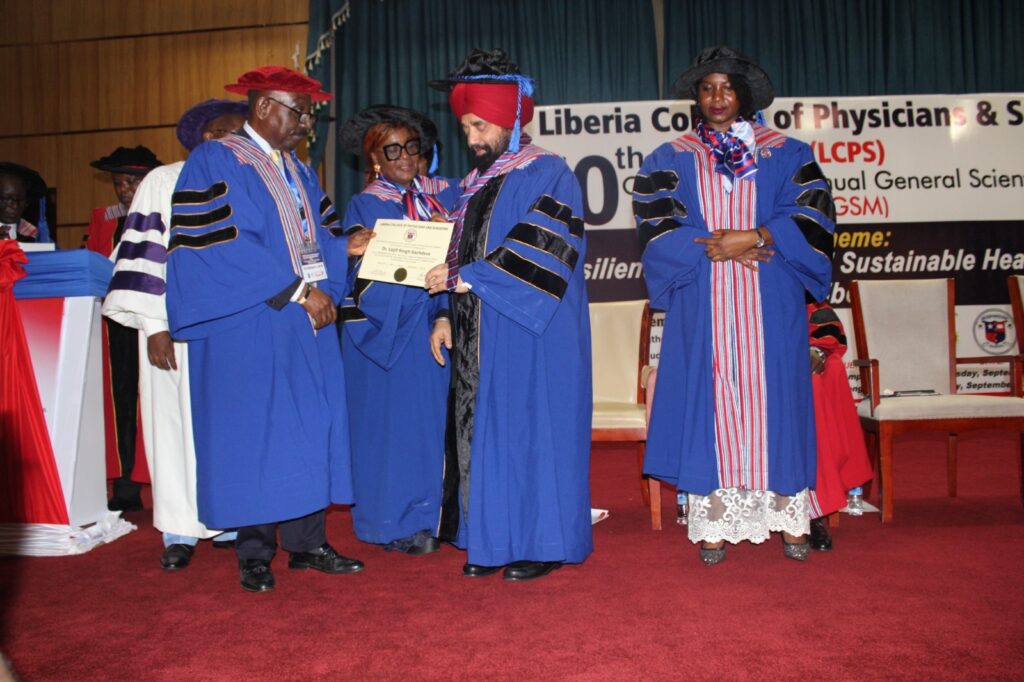
MONROVIA – Businessman and philanthropist Upjit Singh Sachdeva, widely known as Jeety, has been admitted as an honorary fellow of the Liberia College of Physicians and Surgeons, and used the occasion to set out plans to take specialist eye surgery out of Monrovia and closer to rural Liberians.
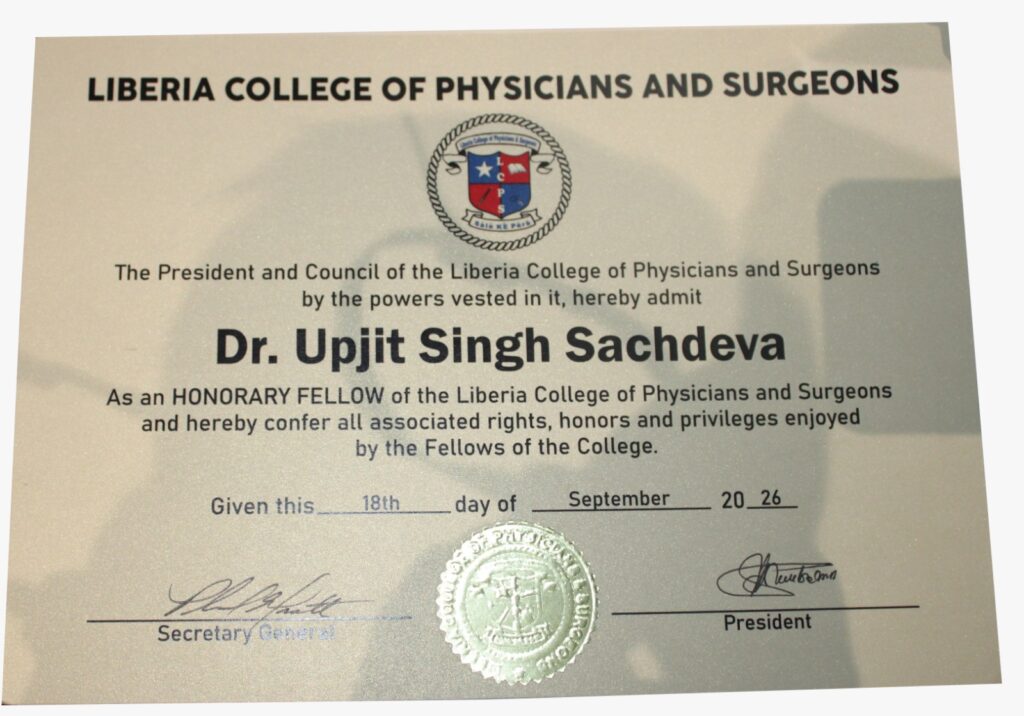
The college conferred its Honorary Fellowship in Medicine on Jeety on Sept. 18 during its 10th Annual General and Scientific Meeting and Convocation Ceremony at the Ministerial Complex in Monrovia, recognizing decades of humanitarian service and his contributions to health care, specialist medical services and care for underserved communities.
In a letter dated Sept. 1, the college said Jeety was selected for his “outstanding humanitarian leadership, extraordinary philanthropy, and invaluable contributions toward the advancement of healthcare and community development in Liberia.” The letter highlighted his support for health initiatives, vulnerable populations, education and community development.
The fellowship confers on him the rights, honors and privileges of the college’s fellows. The college, Liberia’s postgraduate medical training institution, has trained more than 166 Liberian specialists since its founding, and the ceremony drew medical professionals, government officials, fellows, graduating residents and guests.
Jeety said the honor would deepen his involvement in a health system he has supported for years, particularly in eye care, where he has backed the development of the Liberia Eye Center at the John F. Kennedy Medical Center through a partnership with India’s L.V. Prasad Eye Institute.
“This Fellowship strengthens my resolve,” he said. “I will continue supporting partnerships that expand care, build local capacity, and reach people too often left behind.”
Eye surgery closer to home
Jeety said supporting eye care in Monrovia exposed a larger problem. Many patients outside the capital face barriers that have little to do with treatment itself: the cost of transport and accommodation, and the income lost while traveling to Monrovia.
To address that, a 50-bed health center in Weala, supported by Jeety Rubber LLC and Salala Rubber Corporation, is being expanded into a surgical facility with four operating theaters and a dedicated eye unit, he said. The eye unit will cover about 6,000 square feet and be equipped to treat the common eye conditions seen in Liberia, except retinal surgery.
“Bringing patients to Monrovia for surgery and advanced treatments is good, but bringing quality eye care closer to patients is even more practical and sustainable,” Jeety said.
The project will include a mobile eye-care service that will travel into communities to screen and examine patients, referring those who need surgery or further care to Weala.
“Our aim is to enable people in rural communities to receive timely, respectful care to see again the things they loved and care about without needing to come to Monrovia,” he said.
Niranjan Pehere, who Jeety said spent years helping build the Liberia Eye Center at JFK, is returning to Liberia to lead the Weala eye hospital.
Jeety also offered to work with the Ministry of Health and the college to create supervised clinical rotations at the Weala facility for medical residents, subject to the college’s accreditation requirements and a formal agreement, so trainees can gain experience while helping extend specialist care beyond Monrovia.
Nearly four decades in Liberia
Reflecting on almost 40 years in Liberia, Jeety tied his humanitarian work to what he has witnessed during the country’s hardest periods.
“I have witnessed the courage and resilience of Liberians through conflict, reconstruction, Ebola, COVID-19 and many other challenges. Liberia has given me family, friendship, trust, opportunity and belonging. My service is therefore not charity offered from a distance; it is my duty to a country and people I consider my own,” he said.
During the COVID-19 lockdown, he said, his response grew from food for vulnerable families to meals for health workers and patients, delivered three times a day to the 14 Military Hospital and other health facilities. He said more than 110,000 plates of hot meals were distributed in the first 100 days of the lockdown.
That work, he said, showed him the commitment of Liberian doctors and health workers. “I have seen Liberian doctors working very closely with dedication, commitment, sincerity and beyond duty, beyond the call of duty,” he said.
“Healthcare is not only about hospitals and medicine. It is about dignity, livelihood and hope,” Jeety said. “Healthcare has a special place in my heart.”
He linked his philosophy to his Sikh faith and the principle of “Vand Chhako,” which he described as sharing what one has with people in need, including wealth, time, opportunity, knowledge and responsibility.
“A business cannot measure success only by production, exports, or profit. It must also ask whether the community around it is healthier, safer, and better prepared for the future,” he said.
He closed with a line about where he belongs. “I am Indian by passport, Liberian by heart and blood,” he said.




Discussion about this post