


Published: June 3, 2026
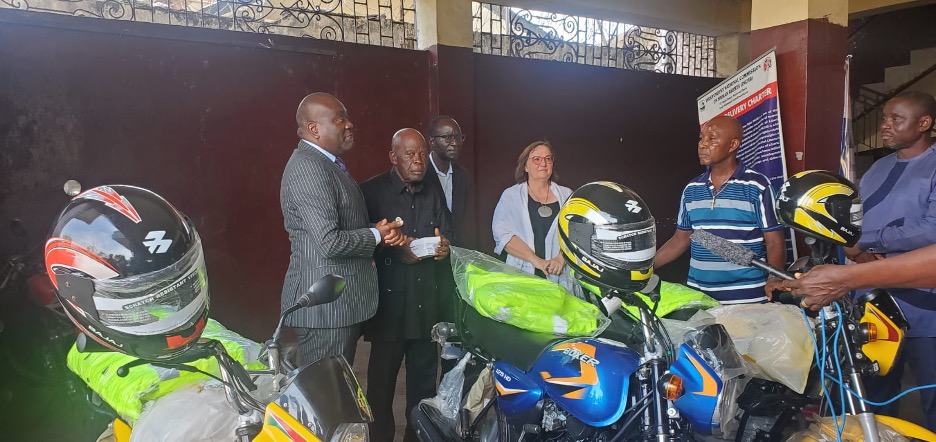
MONROVIA – The United Nations and the European Union have provided motorbikes, mobile phones, and protective gear to Liberia’s Independent National Commission on Human Rights, addressing a longstanding logistical issue that has prevented field monitors from reaching remote communities where human rights violations often go uninvestigated and undocumented.
The equipment, officially handed over Monday in Monrovia by the Office of the United Nations High Commissioner for Human Rights with EU support, includes three motorcycles, helmets, reflector jackets, and mobile phones. Officials said the package is meant to enhance the mobility, responsiveness, and operational reach of INCHR field monitors, especially in rural counties where poor roads and limited transportation have consistently hindered the Commission’s ability to investigate complaints and engage communities.
Christian Mukosa of OHCHR stated that the equipment would directly enhance monitoring activities in hard-to-reach counties like Bong, Nimba, and Grand Gedeh, where infrastructure challenges often delay investigations and documentation.
“This support reflects sustained commitment to strengthening national human rights institutions and advancing accountability, the rule of law and transitional justice,” Mukosa said. “Credible institutions must be adequately equipped to effectively respond to violations occurring beyond urban centers.”
Marie Paule Neuville from the Governance Sector, Human Rights, Democracy and Security Program said the problem the equipment tackles is real. Many abuse cases in rural Liberia go unreported or uninvestigated simply because monitors can’t reach those areas.
“Strengthening INCHR’s operational capacity is essential to ensuring that cases of abuse, often unreported in remote communities, receive attention and response,” Neuville said. “We remain committed to supporting democratic governance, accountability and human rights protection in Liberia.”
Receiving the equipment on behalf of the Commission, INCHR Executive Director Cllr. T. Dempster Brown described the donation as timely and essential, pointing out that transportation issues have long hindered the Commission’s presence in rural areas where communities remain cut off from vital public services and oversight mechanisms.
“This support is timely and necessary for expanding field operations and strengthening the Commission’s ability to engage communities, investigate complaints and respond more effectively to human rights concerns,” Brown said.
He said that motorbikes, in particular, will provide field monitors with the flexibility to reach communities where reports of violations might otherwise go entirely undocumented, and he expressed appreciation to the OHCHR and the European Union for their continued confidence in the Commission’s mandate.
Monday’s handover builds on previous EU-supported assistance, which has included motorbikes and vehicles aimed at enhancing monitoring across Liberia’s 15 counties. Human rights advocates have long recognized logistical constraints as some of the biggest obstacles to effective protection efforts outside urban centers, and stakeholders say the new equipment marks a tangible step toward closing that gap.
The donation coincides with Liberia’s ongoing efforts to strengthen accountability, expand access to justice, and promote transitional justice initiatives related to the country’s civil conflict legacy. Officials state that institutions like the INCHR are key to this process, and their effectiveness relies on their ability to operate throughout the entire country, not just in Monrovia.
The ceremony closed with renewed commitments from the OHCHR, the European Union and the INCHR to continue working together to promote human rights, strengthen democratic institutions and expand access to justice across Liberia.





Discussion about this post