Monday, October 5, 2026
THE LIBERIAN INVESTIGATOR
No Result
View All Result
  • Home
  • Investigations
  • Cocaine Case
  • News
    • General News
    • National News
    • County News
    • Health
    • Human Interest
    • Press Release
    • Media
    • Environment
  • Politics
  • Business
  • International
  • Opinion
    • Opinions
    • Letters from the Editor
    • Letters to the Editor
    • Editorial
    • Commentary
  • Fact Checks
  • Lifestyle
    • Entertainment
  • Sports
  • Women & Grit
THE LIBERIAN INVESTIGATOR
  • Home
  • Investigations
  • Cocaine Case
  • News
    • General News
    • National News
    • County News
    • Health
    • Human Interest
    • Press Release
    • Media
    • Environment
  • Politics
  • Business
  • International
  • Opinion
    • Opinions
    • Letters from the Editor
    • Letters to the Editor
    • Editorial
    • Commentary
  • Fact Checks
  • Lifestyle
    • Entertainment
  • Sports
  • Women & Grit
THE LIBERIAN INVESTIGATOR
No Result
View All Result
Home News

EU Warns Liberia: Fund Your Own Elections or Risk Democratic Credibility

by Blamo N. Toe | The Liberian Investigator
June 3, 2026
in News, UPDATE
Reading Time: 4 mins read
0

Published: June 3, 2026
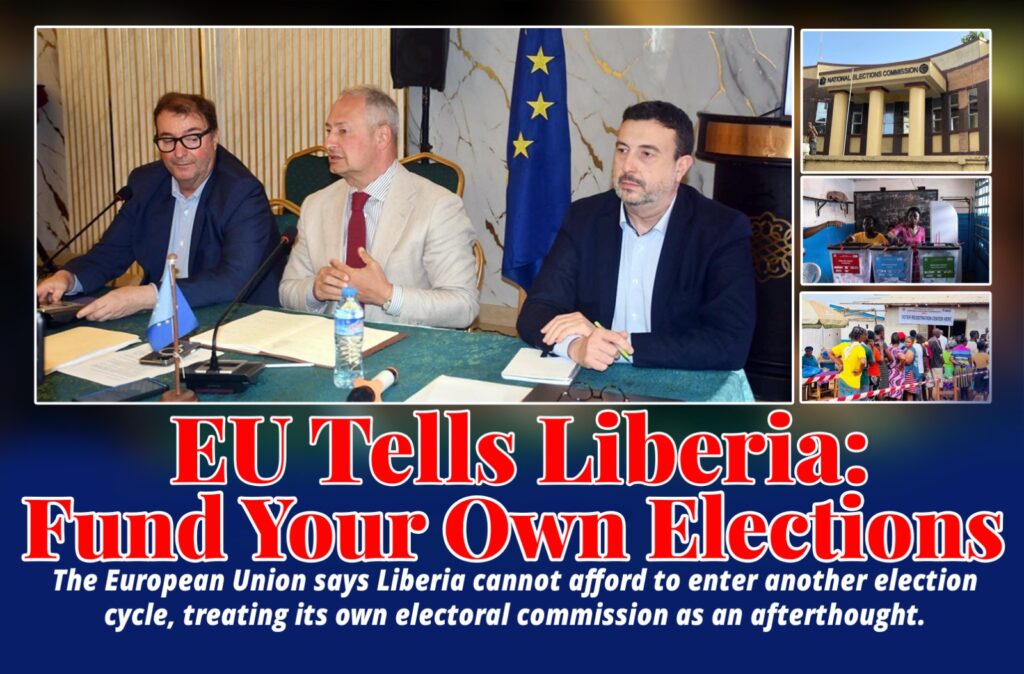
MONROVIA — The European Union has warned Liberia that its repeated failure to fund the National Elections Commission on time is one of the most serious threats to democratic credibility in the country, demanding that election financing become a fixed budgetary line rather than what it called a “political surprise.”

The rebuke came last Friday from Andreas Schieder, head of the EU Election Follow-Up Mission and a member of the European Parliament, who outlined a sweeping set of reform demands at a news conference in Monrovia. Schieder, who also served as chief observer of the EU Election Observation Mission during the 2023 elections, said Liberia must move decisively on multiple fronts before the next electoral cycle in 2029.

“A major issue identified during the 2023 elections was the untimely financing of the National Elections Commission,” Schieder said. “Election funding should be a consistent budgetary item rather than a ‘political surprise.'”

The mission, deployed May 10, was tasked with assessing Liberia’s progress on 22 recommendations the EU issued following the 2023 presidential and legislative elections. Schieder described the mission as independent, nonpartisan and respectful of Liberian sovereignty.

Beyond financing, Schieder identified a cluster of structural deficiencies that hampered the 2023 polls: inadequate voter education, low political participation by women, insufficient voter registration centers and weaknesses in electoral administration.

He called for an increase in the number of voter registration centers nationwide, stronger NEC capacity to enforce campaign finance rules, timely publication of election-related information and enhanced training for polling staff. The mission also recommended harmonizing the existing population register to improve the quality of the voter roll and improving accessibility to polling stations.

Electoral constituency boundaries, the mission said, must be reviewed in accordance with national legislation. Gaps in the electoral legal framework need to be closed, and measures aimed at greater gender equality in political participation must be adopted.

Schieder urged the government, the Legislature and the NEC to move beyond discussions and translate ongoing reform efforts into concrete action before 2029.

“I note a strong commitment from the authorities and most notably from President Boakai to use the EU recommendations as one of the bases to improve the election process,” he said.

The mission met with a broad range of stakeholders during its visit, including President Joseph Nyuma Boakai, the Minister of Justice, the Speaker of the House of Representatives, the President Pro-Tempore of the Senate, the Chief Justice, NEC commissioners, political parties, civil society organizations and members of the international community.

On civic and voter education, Schieder was categorical: it is the single most important factor in improving Liberia’s electoral process. He called for long-term voter education programs to be embedded in the national curriculum rather than compressed into the weeks before election day.

“Education should not just happen in the weeks before an election,” he said. “It should be a permanent fixture of the national curriculum to prepare the younger generation for civic duties.”

He added that constitutional referendums present a heightened challenge. “Referendums on constitutional issues are harder for the public to navigate than general elections, making specialized voter education even more critical.”

Despite Liberia’s turbulent past, Schieder said the country’s democratic trajectory is upward, pointing to the 2023 elections as evidence of strengthening institutions and growing citizen engagement. He acknowledged that election irregularities occur in democracies around the world because elections are administered by human beings, but said the objective is to minimize them through effective oversight and statistical safeguards.

The mission also noted persistent technical and geographic challenges, including polling locations more easily reached from neighboring countries than from within Liberia.

Schieder said the EU’s recommendations, alongside those from domestic and international observer groups, continue to serve as a roadmap for reform. He also stressed the importance of advancing media and social media regulation, campaign finance oversight and mechanisms for resolving electoral disputes.

The EU Election Follow-Up Mission will release its final report in the coming weeks, providing a comprehensive assessment of how far Liberia has progressed on the 22 post-2023 recommendations and offering further guidance ahead of future elections.

Tags: Andreas SchiederEU Election Follow-Up MissionEuropean UnionNational Elections Commission
ShareTweetSend
Blamo N. Toe | The Liberian Investigator

Blamo N. Toe | The Liberian Investigator

Blamo N. Toe is an experienced Liberian journalist with more than eight years in the profession. Known for his investigative depth, ethical standards, and balanced reporting, he covers issues related to corruption, governance, politics, development, climate change, and solution-driven journalism. He holds a “C” Certificate in General Education, an Advanced Diploma in Journalism, and an Associate of Arts Degree in School Administration. He is currently pursuing a Bachelor’s degree in Public Administration and Management at the University of Liberia. A certified fact-checker with both local and international credentials, Toe serves as Senior Reporter for The Liberian Investigator and is the paper’s assigned correspondent to the Liberian Senate. He is the immediate past Secretary-General of the Legislative Press Pool (LEGISPOOL) and a full member of the Press Union of Liberia (PUL).

Next Post
A Liberian student receives an award after winning the Regional Intellectual Property High School Club Competition in Harare, Zimbabwe.

Liberian Students Win Africa IP Competition in Zimbabwe

Mariam Mako Meiplay, founder of Mako's Fruit, displays a fresh fruit platter and healthy lifestyle products in Liberia.

How Mariam Meiplay Turned a Passion for Healthy Living Into a Trusted Liberian Brand

Discussion about this post

Search The Investigator

No Result
View All Result

Recommended

MONROVIA – The Liberia Electricity Regulatory Commission (LERC) and the University of Liberia (UL) have signed a Memorandum of Understanding (MoU) to develop an Energy Auditing curriculum at the University of Liberia, marking a significant step toward strengthening national capacity in energy efficiency and energy management. The partnership aims to equip current and future professionals with the knowledge and skills required to promote efficient energy use and support Liberia’s growing electricity sector. The signing ceremony took place June 15, 2026, at the University of Liberia Fendell Campus. Under the agreement, the University of Liberia will develop a comprehensive curriculum covering energy audit standards, compliance requirements, energy efficiency practices, and related regulatory frameworks. The University will also provide recommendations for periodic updates to ensure that the curriculum remains aligned with evolving energy policies, technological advancements, and applicable laws and regulations. The MoU was signed by Dr. Layli Maparyan, President of the University of Liberia, on behalf of the University, and Hon. Claude J. Katta, Chairman of the Board of Commissioners of LERC, on behalf of the Commission. The signing ceremony was attended by faculty members of the University of Liberia, as well as members of the LERC Board of Commissioners, the Managing Director, and staff of the Commission. Speaking at the ceremony, UL President Dr. Layli Maparyan described the agreement as the beginning of a new era for both the energy sector and the University of Liberia. “This is the beginning of a new dawn in the energy sector and for the University of Liberia,” Dr. Maparyan said. “This initiative will create a network of trained professionals in a specialized area that is critical to national development. We are honored that the University of Liberia has been selected to undertake this important task among the country’s higher education institutions.” She reaffirmed the University’s commitment to ensuring the successful implementation of the agreement and expressed optimism about expanding future collaboration with the Commission. The signing of the MoU with the University of Liberia comes just days after LERC entered another strategic partnership with IECD Liberia aimed at strengthening the licensing and certification of electrical professionals and contractors across the country. In a related development, on June 12, 2026, LERC and IECD Liberia signed a Memorandum of Understanding to support the implementation of the Certified Liberia Electrical Professionals and Contractors Registration (CLEPCR) Program and other initiatives designed to enhance the competence and professionalism of Liberia’s electrical workforce. Under that agreement, IECD Liberia will support key activities including the development of practical laboratory infrastructure at the LOIC Gbarnga Satellite Campus, the establishment and convening of an Examinations Development and Evaluation Committee, the finalization of interview panel guidelines, the development of certification examination blueprints, and the conduct of mock examinations. The partnership will also support the scheduling and administration of regional written and practical certification examinations, application reviews, examination printing and security arrangements, deployment of examination personnel, evaluation of examination results, and regional interviews for certification candidates. Speaking during the IECD signing ceremony, Mr. Alexander Vial, Country Director of IECD Liberia, emphasized the importance of international cooperation in supporting workforce development initiatives in Liberia. “If we are all here together today, we also have to thank the Agence Française de Développement, whose support through the STRIVE Project has enabled us to operate in Liberia over the years,” Vial said. “As the project approaches its conclusion, it is gratifying to see us reaching this important stage of collaboration with LERC. The certification initiative is a critical and impactful project, and we are very pleased to be part of it.” Mr. Vial reaffirmed IECD Liberia’s commitment to supporting LERC through workshops, technical assistance, and other activities outlined in the agreement. In separate remarks, LERC Board Chairman Hon. Claude J. Katta expressed appreciation to both the University of Liberia and IECD Liberia for their partnerships with the Commission. He noted that the two agreements demonstrate a shared commitment to building the technical and professional capacity needed to support a safe, reliable, and sustainable electricity sector in Liberia. The partnerships form part of LERC’s broader efforts to strengthen regulatory compliance, improve professional standards within the electricity industry, and develop a skilled workforce capable of meeting the country’s growing energy needs.

LERC, University of Liberia Sign MoU to Develop Energy Auditing Curriculum

4 months ago
Under his leadership, this is the worst power outage we have experienced. Also, under his leadership as a member of the board before he was self-appointed as its CEO, LEC hired Prish Govender, a fugitive from South Africa who's wanted for fraud.

Letter to the editor: Don’t renew Captan’s contract in November

3 years ago

    Home

    About Us

    Investigations

    News

    Politics

    Business 

    Editorial

    Contact Us

    Privacy Policy

    Advertise with us

    Stay updated with the latest news by subscribing to our WhatsApp Channel

    Click Here to Subscribe

    © 2025 THE LIBERIAN INVESTIGATOR, All Rights Reserved and subject to Terms of Use Agreement. Developed By: Klariba Holdings, Inc

    No Result
    View All Result
    • Home
    • Investigations
    • Cocaine Case
    • News
      • General News
      • National News
      • County News
      • Health
      • Human Interest
      • Press Release
      • Media
      • Environment
    • Politics
    • Business
    • International
    • Opinion
      • Opinions
      • Letters from the Editor
      • Letters to the Editor
      • Editorial
      • Commentary
    • Fact Checks
    • Lifestyle
      • Entertainment
    • Sports
    • Women & Grit

    © 2023