


Published: May 24, 2026
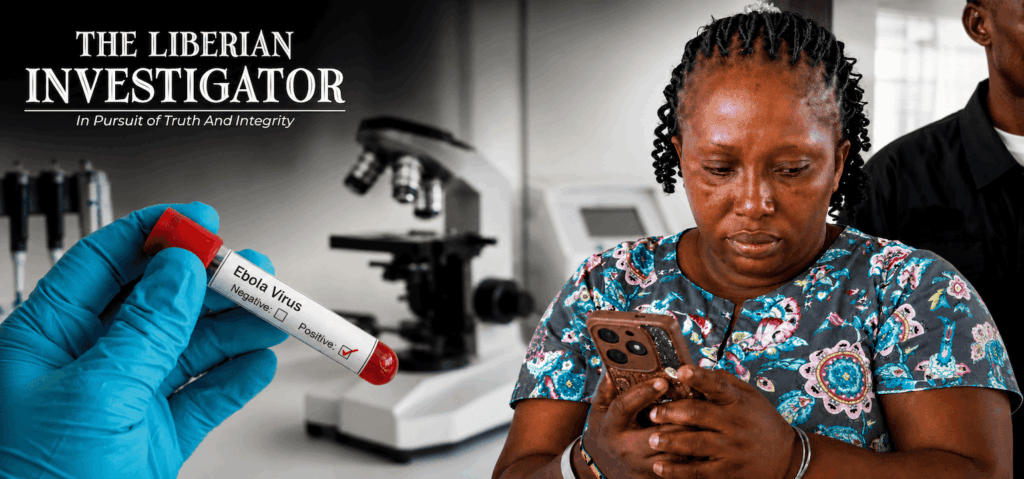
MONROVIA — A recorded voice message allegedly sent by a Liberian nurse claiming Ebola patients had been transferred to a holding center in Monrovia swept across social media Friday, triggering mass panic in a country where the virus killed more than 4,800 people a decade ago — and within hours, health authorities said every word of it was false.
The audio, attributed to a nurse identified as Paola N. Bedell, claimed that travelers returning from a church conference in Uganda had begun displaying Ebola symptoms and had been moved from the John F. Kennedy Medical Center in Sinkor to an isolation facility. It urged Liberians to resume handwashing, avoid physical contact and put on personal protective equipment immediately.
By Saturday, the Ministry of Health, the National Public Health Institute of Liberia and JFKMC had issued a joint denial. Bedell had been arrested and handed to the Liberian National Police.
“Liberia currently has no suspected, probable, or confirmed case of Ebola Virus Disease,” the statement said.
But the damage was done. For several hours, a country still carrying the psychological weight of the 2014 epidemic believed it was happening again.
Health Minister Dr. Louise Mapleh Kpoto described the false message as dangerous and irresponsible, particularly given that neighboring countries are already on heightened alert. Former NPHIL Director-General Dr. Dougbeh Chris Nyan, speaking during a podcast appearance, urged Liberians to ignore social media rumors and trust only official public health channels.
“As far as I am concerned, there is no Ebola outbreak in Liberia,” Nyan said. “Liberians should continue following public health advisories and avoid social media rumors.”
The false alarm did not emerge in a vacuum. Uganda has confirmed five Ebola cases in recent days, including a healthcare worker, a driver and a Congolese national who traveled there from the Democratic Republic of Congo, where the virus has claimed hundreds of lives and infected more than 750 people. The WHO has warned of rapid spread. The Sudan strain driving the current outbreaks remains resistant to vaccines developed for the Zaire strain, complicating regional containment efforts.
Liberia has maintained active disease surveillance at health facilities and border crossings in coordination with WHO, the U.S. Centers for Disease Control and Prevention and the Africa CDC. Authorities say those systems remain intact.
What the false alert revealed, however, is how little separates everyday life in Liberia from the terror of 2014. The epidemic that started when the virus crossed porous borders from Guinea in March of that year ultimately recorded more than 10,000 cases and 4,800 deaths in Liberia alone, making it the deadliest Ebola outbreak in recorded history. Bodies went uncollected in the streets. Treatment centers turned patients away. Hundreds of healthcare workers became infected and died. Schools and businesses shut down for months. Entire families were wiped out.
Communities initially resisted containment measures, partly due to fear and partly because of mistrust developed over years of civil conflict. Traditional burial practices involving contact with the deceased sped up transmission before public health messaging changed behavior on a large scale.
International intervention, from the United States, the WHO, the African Union, Médecins Sans Frontières, and others, eventually brought the outbreak under control. The WHO declared Liberia Ebola-free in May 2015, though sporadic flare-ups followed before transmission was fully eliminated. Handwashing stations that appeared everywhere during the crisis became permanent fixtures. Surveillance systems were rebuilt.
None of it erased the memory. When the audio message spread on Friday, Liberians did not wait for confirmation before reacting — because in 2014, waiting had cost lives.
Public health experts warn that misinformation during outbreaks can function almost as lethally as the pathogen itself, triggering panic, stigmatization, distrust of authorities, and behaviors that overwhelm emergency response infrastructure before a single confirmed case is recorded.
Authorities have not disclosed where Bedell works or what charges she faces. They are urging citizens to report unusual illnesses promptly and to seek updates only from the Ministry of Health and NPHIL.
For now, Liberia remains Ebola-free. Whether Bedell understood what she was unleashing when she recorded that message, or whether she simply did not think it through, is a question authorities say they intend to answer.




Discussion about this post