


Published: April 8, 2026

KPAI DISTRICT, Bong County — Nyamah Dunbar, CEO of Sankofa Farm, welcomed journalists and stakeholders to the farm in Bong County for a hands-on training session targeting vegetable producers across Bong County.
The training, hosted in collaboration with the Ministry of Agriculture (MOA) and the Liberia Vegetable Sellers Association (LVSA), brought together smallholder farmers, cooperative members, and agribusiness participants to strengthen technical skills and market-oriented practices in vegetable production.
The exercise formed part of a daylong intensive training led by seasoned agricultural scientists from Benin, providing both theoretical and practical knowledge to participants.
Sankofa Farm, situated in Electoral District One, Kpaii District along the Palala–Ganta highway, has increasingly become a major agricultural hub for university agriculture students and smallholder farmers in the region. The facility serves as a practical learning center where theory meets real-time farming experience.
The training center itself is strategically positioned in the middle of expansive farmland, showcasing integrated farming systems with mixed crops and vegetables, offering participants a live demonstration environment to apply lessons directly in the field.
Many observers believe that with additional provision of farming tools and modern facilities, the initiative will continue to grow and deliver exceptional impact across the sector.
“Everything is on course,” said Dunbar. “With the changing season and the start of the rains, we are prepared to guide these farmers through the production cycle. This training emphasizes the quality of vegetable production and the practical skills required to boost productivity and profitability.”
Dunbar explained that the training initiative was part of a broader response to farmers’ challenges. Following a recent visit by Liberia’s Agriculture Minister Alexander Nuetah in Bong County, farmers highlighted gaps in coordinated training and knowledge exchange across agribusiness, smallholders, and civil society stakeholders.
“This is phase one of three,” she added, “focusing on technical skills, from seed selection and nursery management to irrigation, soil preparation, and bed construction.”
The training also addresses real challenges faced by smallholder farmers, including access to quality seeds, subsistence-level farming, and high input costs.
“We are helping farmers understand how to source quality seeds, apply organic fertilizers, and adopt practices that increase yield while reducing manual labor burdens,” Dunbar explained.
MOA’s Role in Strengthening Farmer Capacity
Veronica S. Roberts, District Extension Officer for MOA in Kpaii, reinforced the practical nature of the training.

Veronica S. Roberts, MOA Kpaii District Extension Officer, addresses participants at the onset of the training session
“Many farmers struggle with middlemen who control market access,” she said. “This training allows them to learn production practices while connecting directly with market channels. Our goal is to empower them to produce high-quality vegetables and secure fair pricing for their crops.”
Roberts emphasized that the training also promotes collaboration among farmers, facilitating peer learning and networking. Participants are encouraged to replicate and share knowledge within their communities, creating a sustainable impact beyond the farm gate.
LVSA Emphasizes Market-Oriented Production
The Liberia Vegetable Sellers Association (LVSA), represented by Technical Director Duraman A. Fahnbulleh, provided expertise on quality control and market-oriented vegetable production.

Duraman A. Fahnbulleh shares insights with an agriculture reporter at the end of the training session
Fahnbulleh highlighted the importance of producing vegetables that meet consumer standards and market demands.
“Farmers must understand the quality requirements from harvest to market,” he said. “This includes proper handling, storage, and presentation to ensure the product reaches consumers in optimal condition.”
He further explained the concept of market-oriented production.
“Before producing, farmers now consider market demand, pricing, and seasonal consumption patterns. This approach allows them to negotiate better prices and avoid overproduction that can devalue their crops.”
LVSA also introduced participants to practical solutions for storage and market access, including aggregation points and cooling facilities to reduce post-harvest losses. These interventions aim to enhance income and stability for vegetable producers.
Farmers Share Experiences

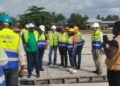
Trainer and participants pictured during a hands-on practical session in the field
The training drew farmers from different districts, each eager to improve their practices.
Jorkpor Guwor, a smallholder farmer from Jorquelleh District, described learning methods to grow vegetables more efficiently.
“We are learning how to make beds, use organic manure, and manage irrigation to improve our yield,” he said. “This training will help me produce more and support my family financially.”
A female participant focusing on pepper production explained the personal impact.
“I now understand how to manage my crops better,” she said. “This knowledge will help me provide for my children and improve our livelihood.”
Martha Jimmy, engaged in vegetable and tomato production, highlighted the importance of applying new techniques.
“I’m learning things I didn’t know before, like soil management and planting methods,” she said. “These practices will increase my productivity and income.”
The Sankofa Farm training exemplifies a holistic approach to agricultural capacity building, combining technical instruction, field-based learning, and market insights. By connecting smallholder farmers with experienced trainers from Sankofa Farm, MOA, and LVSA, the program aims to enhance production quality, improve market access, and ultimately strengthen Liberia’s vegetable value chain.
Participants expressed appreciation to the Ministry of Agriculture and Sankofa Farm for the initiative, pledging to apply the knowledge gained to improve their productivity and livelihoods.



Discussion about this post