


Published: November 20, 2026
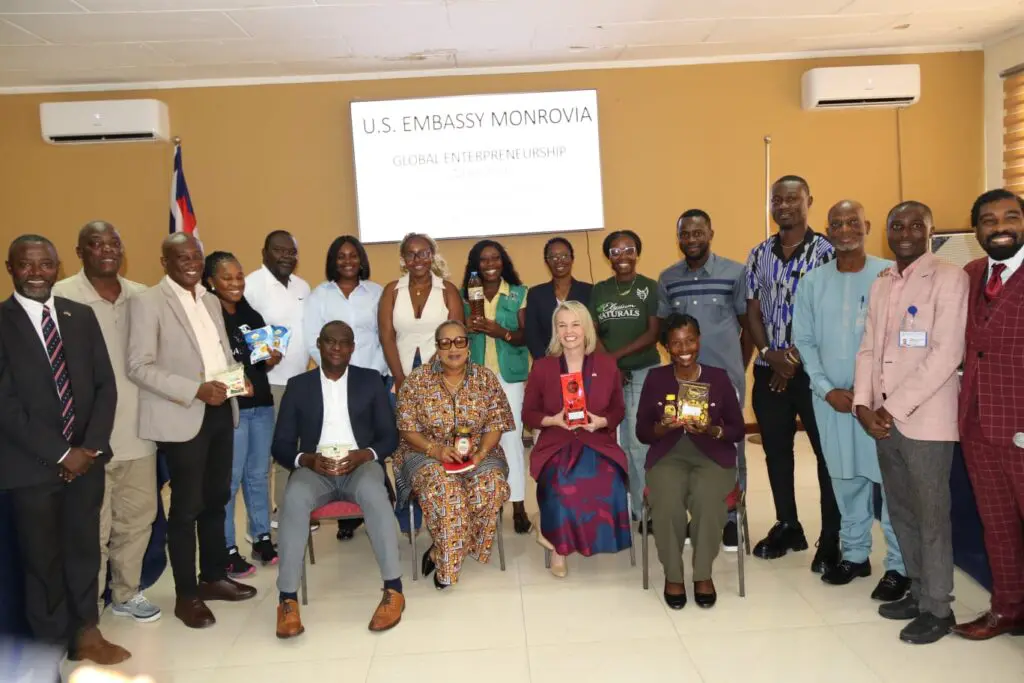
MONROVIA — For Liberian businesses hoping to reach American consumers, the opportunity is significant. But getting a product from a farm, workshop or processing centre in Liberia onto a shelf in the United States requires more than finding a buyer. It demands quality control, proper certification, reliable production, accurate documentation and an understanding of the rules governing international trade.
That was the central message from government regulators, business representatives and the United States Embassy during a Global Entrepreneurship Week gathering in Monrovia on Thursday, as Liberia renewed its push to expand exports under the African Growth and Opportunity Act, known as AGOA.
The event, held at the Liberia Chamber of Commerce, brought together small and medium-sized enterprises and institutions responsible for standards, customs, food safety and commodity regulation under the theme, “Building Export-Ready Liberian SMEs: One Export Pathway to AGOA.”
The discussions came as the United States extended AGOA through Dec. 31, 2028, giving eligible African countries additional time to take advantage of preferential access to the American market. Liberia remains eligible for the program in 2026, including its textile and apparel benefits.
For Liberia, the extension presents another opportunity to turn locally produced goods into export earnings, support businesses and create jobs. But the presentations made clear that access to the American market does not automatically translate into successful exports.
U.S. Embassy Chargé d’Affaires Kristin Gilmore said the United States welcomes increased exports from Liberia and wants to see more Liberian businesses take advantage of the trade arrangement.
“There are currently 6,500 products that can come into the United States 100% duty free,” Gilmore said, encouraging Liberian entrepreneurs to consider the United States as a market for their products.
She described the American market as a major opportunity for Liberian producers, saying increased exports could help businesses grow, generate revenue and create income opportunities for families.
“The United States wants to do more business with Liberia. Liberia has more to offer to the American market than I think many people realize,” she said.
Gilmore pointed to the export performance of other African countries to illustrate what could be possible. She cited Kenya’s textile and apparel exports to the United States, valued at roughly $500 million annually, alongside Madagascar’s estimated $355 million and Lesotho’s exports of more than $100 million.
She said Liberia does not have to build a large textile industry overnight to benefit from AGOA, noting that existing Liberian products could find opportunities in the American market if producers meet the required standards.
“I would encourage them to look at the quality of their products and make sure that they are creating products of the highest quality and get the right products to the right consumers at the right price in the United States,” she said.
Gilmore also pointed to J-Palm, a Liberian business already exporting palm oil to the United States under AGOA, as an example of the opportunities available to local producers.
But the experience of entrepreneurs who have attempted to enter foreign markets suggests that the journey can be demanding.
Rep. Rugie Yatu Barry of Montserrado County District No. 1 offered one of the clearest accounts of what it takes to prepare a Liberian product for export, drawing on her experience in business and cassava processing.
Barry said her entrepreneurial journey included establishing the Liberia Business Incubator in November 2010 and participating in the African Women Entrepreneurship Program, a U.S. State Department initiative.
During a visit to an African store in the United States through the program, she encountered products such as fufu powder and plantain flour. The experience prompted her to consider how Liberian agricultural products could be processed and marketed beyond the country’s borders.
She subsequently began working with women farmers to source cassava and process it into flour for export.
But her early experience exposed problems that could have undermined the business.
Barry recalled that an initial batch of cassava flour contained sand, forcing her to recall the product and review the production process. Later, during a food microbiology program at Pennsylvania State University, laboratory testing revealed bacteria in her product.
She traced the contamination to the well water used to wash the cassava.
The experience, she said, taught her that producing a food item for export requires more than having a marketable product. It requires safe water, strict hygiene, proper processing and consistent quality.
Packaging and labeling also presented challenges. Barry said products intended for export needed information such as barcodes, expiration dates, nutritional facts, ingredients and product composition.
At the time, she had to send products to Ghana for nutritional analysis because she could not access the appropriate laboratory services in Liberia.
She also discussed the regulatory and logistical requirements she encountered, including food safety procedures, U.S. Food and Drug Administration registration, certificates of origin and phytosanitary documentation. Some requirements depend on the product and destination, but her experience illustrated the importance of understanding the applicable rules before shipping.
Barry recounted an export shipment that encountered documentation problems involving a phytosanitary certificate. The absence of the required document and the unavailability of her U.S. broker after he travelled abroad delayed the container and exposed her business to nearly $11,000 in storage charges.
Her account highlighted a critical point for businesses seeking to export: duty-free access does not mean that shipping, inspection, certification, storage and other trade-related costs disappear.
The challenge, therefore, is not only producing goods that can attract foreign buyers. Businesses must also prepare the paperwork, logistics and finances needed to move those goods across borders.
That issue featured prominently in the presentation by Saa Saamoi, Commissioner of Customs at the Liberia Revenue Authority.
Saamoi explained that AGOA benefits are tied to rules of origin, meaning that goods must genuinely qualify as products of an eligible country. Simply packaging or labeling a product in Liberia does not make it Liberian-origin if the goods were manufactured elsewhere and do not meet the applicable origin requirements.
He said businesses must understand the rules governing the products they intend to export, including requirements relating to the origin of components and the level of processing or transformation.
Customs procedures and the cost of moving goods through the port also remain important considerations.
Saamoi referenced a time-release study showing that average cargo clearance at the port takes 12 days and 19 hours. He said about 65% of cargo could potentially be cleared within zero to five days, while delays also arise from factors beyond Customs.
He attributed a substantial share of the average clearance time to importers themselves, particularly small businesses that struggle to mobilize funds and plan adequately for customs charges and other costs.
Businesses unable to settle their obligations may face storage and demurrage charges, adding to the cost of getting goods through the port. Saamoi warned that goods left uncleared for 90 days could be subject to auction under the law.
He also announced plans for a fully electronic customs payment system beginning Jan. 1, 2027, which is expected to allow traders to process declarations, submit documents and make payments remotely.
A National Trade Single Window is also expected within the next 15 months, with the aim of bringing different regulatory processes into one integrated platform.
For businesses, such reforms could reduce the need to move between institutions and help make trade procedures more predictable.
However, meeting customs requirements is only one part of the export process. Products must also satisfy the quality and safety standards of the markets they are entering.
Stephen Yongar Mambu, Director General and CEO of the Liberia Standards Authority, said the institution’s role is to help businesses understand and meet the technical requirements that determine whether products can compete in foreign markets.
He said standards, testing, inspection, certification and accurate product information are central to building confidence in Liberian exports.
Mambu stressed that meeting local requirements alone may not be sufficient when a business is targeting the United States, because exporters must understand the rules and technical standards of the destination market.
For processed foods, spices, palm products and cassava-based goods, for example, exporters may have to meet food safety, labeling and facility requirements. Seafood products face their own safety and traceability rules, while textiles, cosmetics and other manufactured goods are subject to separate standards.
To address the information gap, the Standards Authority is preparing to establish a Market Access Unit that will provide guidance on AGOA requirements, help businesses assess product readiness and connect exporters with relevant testing and certification services.
Mambu said the authority is also preparing sector-specific guidance materials, screening tools and other resources to help businesses understand the requirements before committing money to an export shipment.
He disclosed plans to establish an Exporter Help Desk and hold an initial briefing within the next three months.
The proposed support system could give businesses a point of contact to clarify technical requirements, identify gaps in their products and receive referrals to institutions capable of providing the necessary services.
The Food Authority of Liberia also outlined the process businesses must follow when exporting food products.
During a presentation, Sunday J. Kerkulah explained that businesses must first register with the Ministry of Commerce and Industry and obtain the relevant license from the Food Authority.
The process includes product listing, submitting samples and information on ingredients and specifications, inspecting production facilities, and testing through relevant institutions.
He said the authority assesses product safety and quality before issuing the required export certification.
The presentation also outlined fees for premise registration, product listing, export permits, and certification, with costs varying by ownership and other requirements.
For entrepreneurs, the process reinforces the need to establish regulatory compliance early rather than waiting until a buyer or shipment is already in place.
The Liberia Agriculture Commodity Regulatory Authority, which oversees the regulation and quality authentication of key agricultural commodities, also addressed the requirements facing exporters.
Its presentation focused on the structure of commodity trade, including producers, middle buyers, and exporters, as well as the licensing and inspection procedures governing these activities.
The presentation highlighted the importance of proper warehouse facilities, quality control, relevant business documentation and the correct licensing category.
It also emphasized that quality assurance begins at the farm and continues through buying, storage, processing and shipment.
Together, the presentations offered a picture of the institutions businesses must navigate before their products can reach international markets. They also exposed a need for stronger coordination and more accessible guidance so that entrepreneurs are not left to discover critical requirements after production or shipment has begun.
For the United States, the opportunity is not limited to opening its market. Gilmore said the Embassy wants to connect Liberian small and medium-sized enterprises with the institutions that can help them become export-ready.
She encouraged businesses to focus on quality, identify the right consumers and ensure their products are competitive in price.
The larger question is whether Liberia can use the extended AGOA window to move beyond discussing export potential and build a stronger pipeline of businesses capable of consistently supplying foreign markets.
The United States Trade Representative lists Liberia as an AGOA-eligible country for 2026. But national eligibility does not mean every Liberian product automatically qualifies for duty-free treatment; businesses must still meet the program’s product-specific rules and applicable U.S. requirements.
That distinction matters. A trade preference can reduce the tariff burden on qualifying goods, but it cannot replace reliable production, quality assurance, certification, financing, packaging, transport or access to buyers.
For Liberian entrepreneurs, the opportunity is real, but so is the work required to seize it.
As the 2028 deadline approaches, government institutions and the private sector must make export information easier to access, improve coordination among regulators, strengthen local testing and certification capacity, and help businesses build the systems needed to compete.
Liberia has products that can reach international markets. The challenge now is to ensure that more of those products leave the country not simply as shipments, but as credible, compliant and competitive exports capable of sustaining businesses, creating jobs and earning revenue for the country.




Discussion about this post