

Published: November 20, 2026
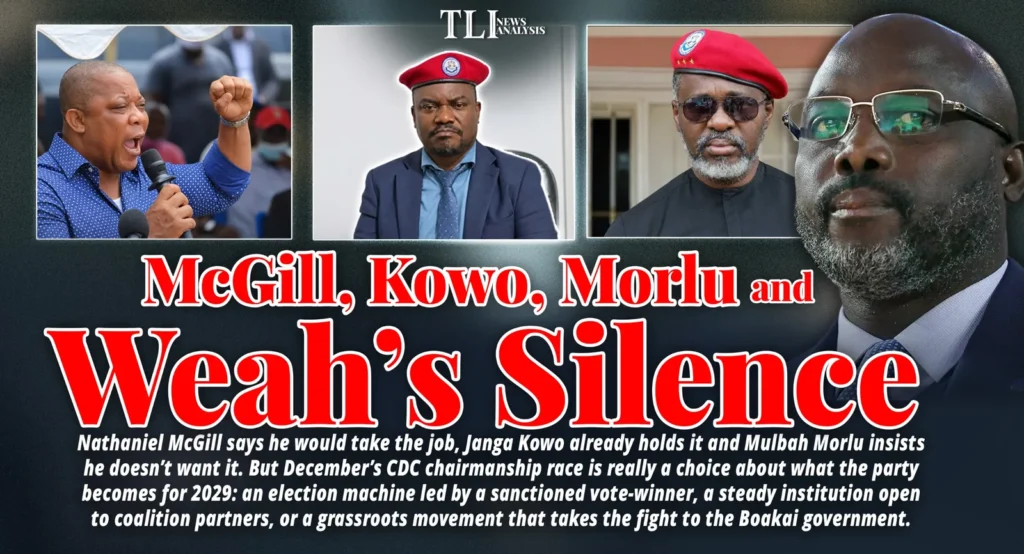
MONROVIA — When delegates of the Congress for Democratic Change gather at Smell No Taste in Margibi County from Dec. 11 to 13, they will be choosing more than a chairman. They will decide what kind of opposition party George Weah’s movement wants to be on the road to 2029, and how much of that decision Weah intends to make himself.
The party’s National Executive Committee announced the dates Thursday, saying the Extraordinary Congress will address “leadership vacancies and the Party’s strategic direction” and propose constitutional changes.
Three names dominate the conversation. One has said he would take the job. One already holds it. And one insists he does not want it.
The willing senator
Sen. Nathaniel F. McGill of Margibi County has come closest to declaring. “I am interested in anything CDC wants me to do. If they want me to be chairman, I’ll be chairman to the best of my ability,” he said on Nov. 2.
His supporters are moving as if it were a formal bid. Former Rep. Acarous Moses Gray has been reported among those backing him, and on Nov. 4 the Movement for Digging Deeper, a CDC auxiliary, endorsed a ticket with McGill as chairman and Jefferson Tamba Koijee as secretary-general.
McGill’s strongest card is one his rivals cannot match: a recent countywide win. In the 2023 Margibi Senate race he took 52,934 votes, or 39.89%, more than twice his nearest challenger, according to National Elections Commission results. He has chaired the party before and won the 2017 presidential election. As Weah’s minister of state and chief of staff, he sat at the center of the last CDC government. He has even claimed the Unity Party would not have won in 2023 had he stayed in that post. The claim cannot be tested, but it shows how he sees himself: as the organizer the party lacked when it lost.
His heaviest burden remains current. In 2022, the U.S. Treasury Department sanctioned McGill under its Global Magnitsky program, accusing him of bribery, kickbacks, procurement manipulation, and misappropriation of government assets. Those are findings Washington used to impose financial sanctions, not convictions by a Liberian court, and McGill denies them. He remains on the Treasury’s sanctions list. In August, The Liberian Investigator reported on an April 2025 Treasury letter rejecting his request for delisting, stating that his election to the Senate had returned him to a position of public trust. In March, the Liberia Anti-Corruption Commission cleared him, but only in a specific payroll-padding investigation at the Ministry of State.
McGill turns the sanctions into an argument. “Despite being sanctioned, the Liberian people still voted for me and elected me as senator,” he said this month. Margibi voters plainly did not treat the designation as disqualifying. But a chairman is also the party’s chief fundraiser, its link to the diaspora and its face to foreign partners, and sanctions generally bar U.S. persons from most dealings with a designated individual. Delegates may weigh that more heavily than voters did.
The steady incumbent
Atty. Janga A. Kowo holds the office and has been reported as intending to keep it.
He took over in March 2024 after Mulbah K. Morlu Jr. resigned. Koijee announced then that Kowo had been chosen as acting national chairman “with the support” of Weah, with a convention to follow.
Kowo’s résumé is long on institutions: CDC secretary-general from 2015, vice chair for legal affairs, and comptroller and accountant general under Weah. His chairmanship has been defined by survival. He led the party through the court fight over its Congo Town headquarters and the eviction that followed, and was briefly detained by police in June 2025 during protests over the jailing of former House Speaker J. Fonati Koffa.
He has so far kept a defeated party standing through its leanest years. His rivals will argue that keeping a party standing is not the same as rebuilding the machine that once won the presidency and controlled the nation’s grassroots. He is the only one of the three with a documented Weah endorsement, though it dates from 2024. When he welcomed Morlu back on Nov. 15, Kowo said he spoke on behalf of Weah and the National Executive Committee. That shows he still speaks for the leadership.
The man who says he isn’t running
Morlu is the hardest to read and the easiest to overstate.
He chaired the CDC through its years in power and was re-elected by white ballot in 2022. His relationship with Weah has had public ruptures, most memorably a 2019 leaked recording of harsh remarks about the then-president that he later called “liquor talk.” He resigned the chairmanship in February 2024 and left the party that June to lead STAND, a group he described as nonpartisan.
On Nov. 14 he came back, telling supporters the CDC should stop engaging the Boakai government and “confront” it, The Liberian Investigator reported. Then he appeared to close the door on the chairmanship.
“I’m not coming because I desire office. I don’t need title to be effective. I don’t need title to serve,” he said, adding that whoever wins must reconcile the party’s factions rather than silence dissent.
The movement around him is real but hard to measure. The petition urging his return claimed support in all 15 counties, but it listed no individual names. Eligibility is another question: his membership was restored only on Nov. 14, and the party has not published a current constitution showing what the chairmanship requires.
The referee in the middle
The congress will be run by a convention committee chaired by Koijee, with Ronald Kerkula Menscole heading a separate elections committee and Thompson Jabber a constitutional review committee.
Koijee’s position is unusual. He announced Kowo’s elevation in 2024 and reaffirmed him as chairman in October. Now an auxiliary has named him McGill’s preferred secretary-general, an endorsement he has not publicly addressed. However he handles it, the overlap will shape how a losing camp reads the result, and is reason enough for the party to publish its delegate list and nomination rules early.
The Weah question
No public statement shows that Weah has endorsed anyone, and that silence is the most important fact in the race.
Each contender’s standing runs through him. McGill’s political identity is inseparable from his years as Weah’s closest aide. Kowo owes his office to Weah’s 2024 blessing. Morlu’s chairmanship ended as his relationship with Weah frayed, and his return depends on a leadership that speaks in Weah’s name, welcoming him home.
In the first round of the 2023 presidential election, Weah led Boakai 43.83% to 43.44% and still lost the runoff. That result holds the CDC’s central lesson for 2029: its base can carry it to the edge of victory, but not across the line.
What delegates are really choosing
Set the personalities aside and three models of opposition emerge.
McGill offers an operator who has proved he can win votes under heavy pressure, and who carries an international burden the party would carry with him. Kowo offers stability and an institutional manner that may ease work with the partners who signed September’s opposition communique. Morlu, if he can be drafted, offers the grassroots fire of the CDC’s past and the confrontational posture his supporters say the party has lost.
None of them can yet prove his model wins a national election. Until Weah signals a preference, or pointedly declines to, the race is less a three-way contest than an emerging bid against an incumbency, with a reluctant third man whose supporters are testing whether a return to the party can become a return to power.
Discussion about this post