


Published: November 13, 2026
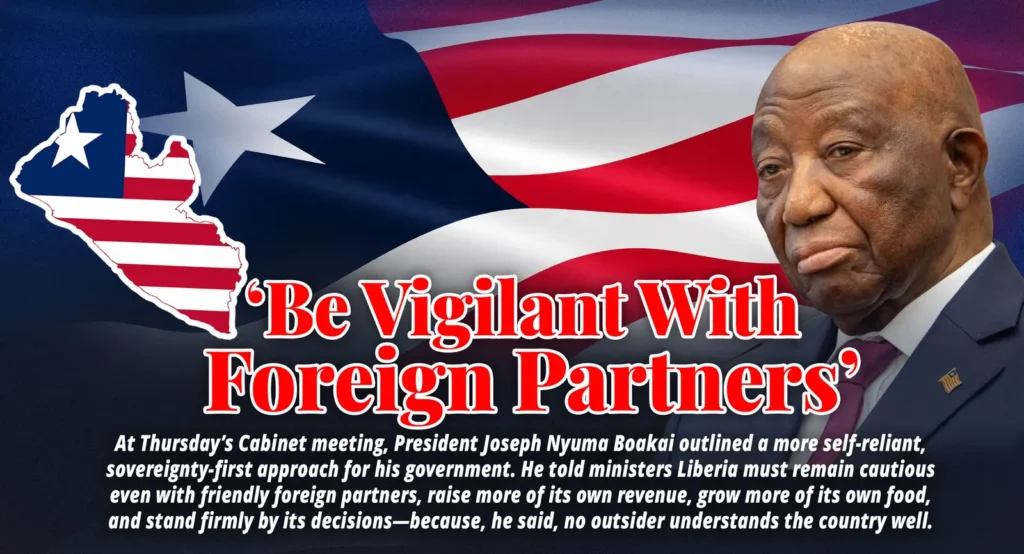
MONROVIA — President Joseph Nyuma Boakai told his Cabinet on Thursday that recent arrests involving Chinese nationals mean Liberia must be “a bit more vigilant with foreign partners.” He also insisted that the government, not its international backers, must own its decisions on investment and the economy.
“We’ve been having some little problems with all of these arrests with the Chinese,” Boakai said in his opening remarks at the Executive Mansion, adding that the country must be careful even with partners it considers good ones in order to protect itself.
Boakai did not specify which arrests he meant. Authorities have repeatedly arrested Chinese nationals this year for illegal mining, including nearly 20 in Montserrado County in May, in an operation led by the Environmental Protection Agency with police support, and a group detained during a June raid in Gbarpolu County. Boakai has established a national taskforce to crack down on illegal mining.
The president said he was satisfied with the security sector’s work and said Liberia’s investment decisions are “intended for us.”
“I don’t care how much people understand Liberia, they cannot understand Liberia as much as we do because they can’t understand all of the political twists and turns,” Boakai said. He said the government appreciates its partners’ support and advice but must ultimately take responsibility for its own choices, and told ministers that once the Cabinet reaches a decision, “we should rally around it.”
The meeting, the 26th of Boakai’s Cabinet, opened with the introduction of Cllr. N. Oswald Tweh as the new minister of national defense. Boakai named Tweh acting defense minister on Sept. 11, days after removing him as justice minister.
Boakai spent much of his address pressing ministers on performance and accountability. “Performance, performance, performance,” he said, adding that officials work for the public and must keep records and account to the people.
He praised the revenue agencies for raising what he called a sizable amount of money and said the country had shown it can generate resources locally, though he noted the gap between what Liberians pay and what they expect. “It is not a country in which people pay a lot of taxes, but we expect a lot of benefit,” he said.
“The national budget is for public welfare,” Boakai said, describing the upcoming budget as “the people’s budget.” He said groups including motorcycle riders, young people and dormant organizations such as the Boy Scouts, which the government is trying to revive, “have been included this year in the budget.”
On the economy, Boakai credited what he called prudent management for the absence of fuel queues despite global pressures. “Even up to now we don’t see people queuing up at gas stations,” he said. He said a staple commodity had remained both affordable and available, and urged ministers to push agricultural production, particularly now that the government has new equipment, so the country does not depend on outside food supplies.
He also said he had been told that work on airport access was progressing and that the government wants people to have very good access by the end of the year.
Boakai noted that the vice president was out of the country on official business.
The Cabinet’s agenda included a Government Employee Housing Initiative Framework presented by a special housing committee led by Civil Service Agency Director-General Josiah F. Joekai, a youth empowerment and development policy from the Ministry of Youth and Sports, and a discussion on economic growth led by the president’s economic adviser. Reporters were asked to leave before the deliberations.



Discussion about this post