


Published: November 12, 2026
MONROVIA — Liberia’s electoral system is facing renewed calls for comprehensive reforms ahead of the 2029 elections, as election observers, civil society organizations and governance institutions push for greater independence of the National Elections Commission (NEC), increased women’s political representation, accessible voting for persons with disabilities and a review of constituency boundaries.
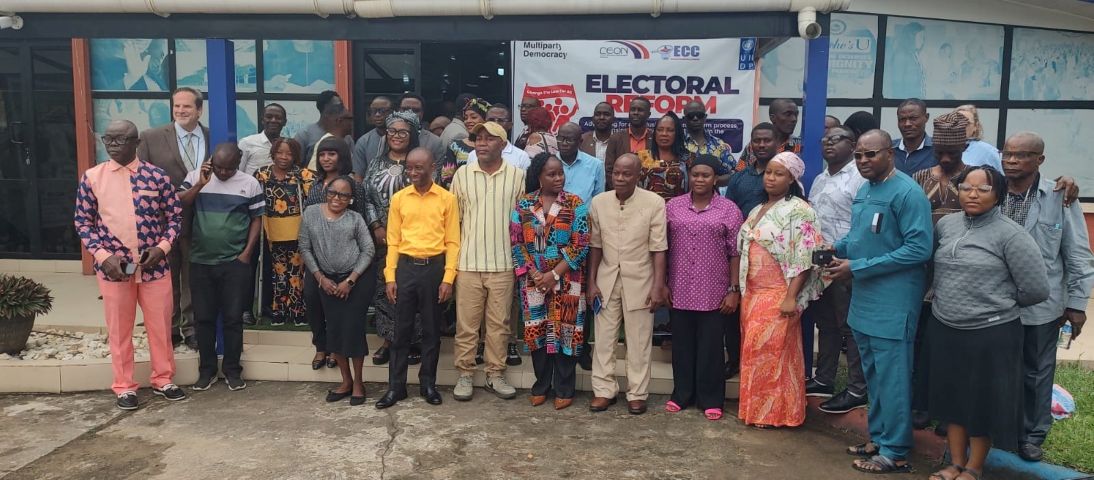
The calls emerged Thursday, during a National Stakeholders’ Dialogue on Electoral Reform in Monrovia, where participants raised concerns about institutional, legal and operational weaknesses exposed during previous elections, particularly the 2023 general elections.
Organized by the Liberia Elections Observation Network (LEON) and Elections Coordinating Committee (ECC), the dialogue was held under the theme, “Inclusive, Credible and Citizen-Centered Elections for a Stronger Liberia.”
The initiative received technical support from the Netherlands Institute for Multiparty Democracy through the Liberia Electoral Support Project, managed by the United Nations Development Programme, with support from the European Union, Ireland, Sweden and UN Women.
Providing an overview, LEON Administrator Pilate Johnson said Liberia has made progress in sustaining democratic governance, but successive elections have exposed weaknesses requiring coordinated reforms.
“The 2023 General Elections, in particular, provided important lessons and generated recommendations from the National Elections Commission, domestic election observation organizations, and regional and international observation missions,” Johnson said.
He identified four priority areas: women’s political representation, voting accessibility for persons with disabilities, constituency boundaries and legislative seat apportionment, and the independence and effectiveness of the NEC.
Johnson expressed concern that women’s participation remains limited despite provisions encouraging political parties to ensure that neither gender constitutes less than 30% of their governing bodies and candidate lists.
He also emphasized the need to address barriers preventing persons with disabilities from independently exercising their voting rights.
“It must be an inclusive national process informed by evidence, dialogue, consensus, and the experiences of citizens who participate in and are affected by the electoral system,” Johnson said.
Melvin L. Harding, acting president of the National Union of Organizations of the Disabled, said visually impaired voters frequently depend on others to cast ballots, potentially compromising voting secrecy.
He also highlighted challenges confronting deaf and speech-impaired citizens, including inadequate interpretation services and inaccessible election information.
Harding called for accessible polling facilities, appropriate voting materials and improved communication systems.
Speaking on behalf of the NEC leadership, Commissioner Cllr. Ernestine Morgan-Awar reaffirmed the commission’s commitment to free, fair and transparent elections.
“Democracy is key in moving Liberia forward,” she said. “It can’t be handled without proper governance.”
Morgan-Awar disclosed that the NEC is undertaking reforms involving civic and voter education, data management, decentralization and institutional capacity development.
She emphasized the importance of continuous voter education and improved recruitment and training of temporary electoral workers.
The commissioner also disclosed plans to introduce biometric voter verification following the implementation of biometric voter registration, while proposing a training center for electoral personnel.
Meanwhile, Press Union of Liberia President Julius Kanubah questioned the NEC’s independence, particularly the political appointment process governing its leadership.
“The consolidation of elections in Liberia remains shaky,” Kanubah said. “Women and youth are being heavily excluded.”
He warned that anticipated changes within the NEC’s Board of Commissioners before 2029 could affect public confidence in the institution.
Kanubah recommended a multistakeholder approach to electoral governance and renewed calls to transform the Liberia Broadcasting System into an independent public service broadcaster.
“LBS operation under the Executive Branch of government, especially the Presidency, needs to be looked at,” he said.
For his part, Governance Commission Executive Director Jallah Kesselly warned that disputed elections could threaten Liberia’s peace and democratic stability.
Referencing the controversial 1985 elections and subsequent political unrest, Kesselly stressed the importance of credible elections in preventing instability.
He pledged the commission’s support for electoral reforms and continued collaboration with LEON and other stakeholders ahead of 2029.
The dialogue also examined constituency boundaries and legislative seat apportionment following the 2022 National Population and Housing Census, alongside proposals for greater transparency in appointing NEC commissioners.
Johnson said the engagement was intended to generate practical recommendations and build national consensus rather than impose predetermined positions.
“We expect the dialogue to produce practical recommendations and stronger collaboration to ensure every vote is protected and every voice matters,” he said.



Discussion about this post