

Published: November 11, 2026
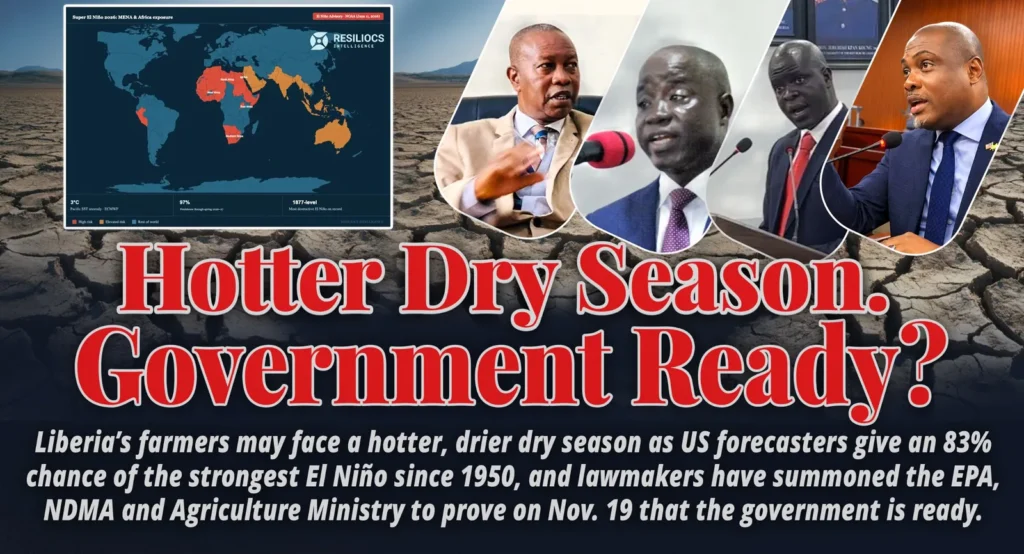
CAPITOL HILL, Monrovia — Liberia is entering its dry season amid an El Niño that US forecasters say could be the strongest on record. Lawmakers now want the government to show whether it has a plan to protect farmers, food supplies and public health before the heat arrives.
The House of Representatives has summoned the Environmental Protection Agency, the National Disaster Management Agency, and the Ministry of Agriculture to appear on Thursday, Nov. 19, to explain their preparations. The order followed warnings from Rep. Taa Z. Wongbe of Nimba County District 9, who told plenary that the country faces serious consequences for its food supply and economy if it fails to act.
“If you’re importing pepper from Guinea, it’s going to be very expensive. When you’re importing things from Ghana and other places, it will be very expensive,” Wongbe said.
In its Nov. 9 update, the US National Oceanic and Atmospheric Administration’s Climate Prediction Center said El Niño is present and continuing to strengthen, with a strong-to-very strong event likely. The agency estimates an 83% chance of a historic event, one exceeding every El Niño since 1950, for October through December. The World Meteorological Organization says El Niño will likely persist through February 2027.
El Niño is a natural warming of the surface waters of the central and eastern tropical Pacific that shifts temperature and rainfall patterns worldwide. For Liberia, the main concern is the months ahead. Liberian climate expert Isaac Nyaneyon Kannah Teah told New Narratives in September that El Niño may bring a hotter, drier January-to-March dry season, straining water supplies, agriculture, forests, and electricity generation, and could produce false rainfall starts that lead farmers to plant too early.
Wongbe said more than 70% of residents in his district depend on farming, and he questioned whether information about the risks is reaching them even if the Agriculture Ministry and other agencies have begun preparing.
His concern is borne out by the country’s forecasting capacity. Albert Momolu Sherman, director of the Liberia Meteorological Service, told the same outlets that the service has no marine weather station to measure sea surface temperature and relies on global models. The service publishes a 10-day agricultural bulletin, but getting it to communities without reliable radio, internet or electricity depends on partnerships with the Liberia Telecommunications Authority, the National Disaster Management Agency and the Red Cross that have yet to fully materialize, the report found.
The Famine Early Warning Systems Network said in October that West Africa’s reliance on imported rice exposes it to upward price pressure if El Niño cuts production in India and Thailand or prompts renewed Indian export restrictions. The World Food Programme projects that food insecurity in West and Central Africa will rise 12% because of El Niño, affecting nearly 6 million additional people. Guinea and Côte d’Ivoire, both Liberian neighbors and trading partners, are among the West African countries the Food and Agriculture Organization and WFP named as priorities in their El Niño anticipatory action appeal.
Wongbe also pointed to the unusual rain and thunderstorms Liberia has seen this month, when the dry season would ordinarily be setting in.
“You are seeing it happening right now where everyone’s saying the dry season is going to be very hot, right? You saw how the rain came this rainy season. These are all symptoms of El Niño,” he said.
Climate agencies have not attributed Liberia’s recent rains to El Niño. The FAO says El Niño has historically brought below-average rainfall to West Africa and the Sahel between July and September, and the WMO cautions that the strength of an El Niño event does not translate directly into the magnitude of impacts in any region.
When they appear, the three agencies are expected to brief lawmakers on their preparedness measures, public awareness efforts and plans for climate-related disruptions. The NDMA is to address disaster preparedness and response, and the Agriculture Ministry is to explain how it will protect farmers. The House has also asked the EPA to bring Liberia’s national carbon footprint data.
NOAA’s next monthly El Niño assessment is scheduled for Thursday, Nov. 12, a week before the agencies face lawmakers.


Discussion about this post