


Published: November 9, 2026
MONROVIA — Customs intelligence officers from West and Central Africa want their governments to toughen penalties for trafficking and illicit financial flows. They also want part of the money customs services collect from offense cases set aside to pay for the intelligence work used to track smugglers across the region’s borders.
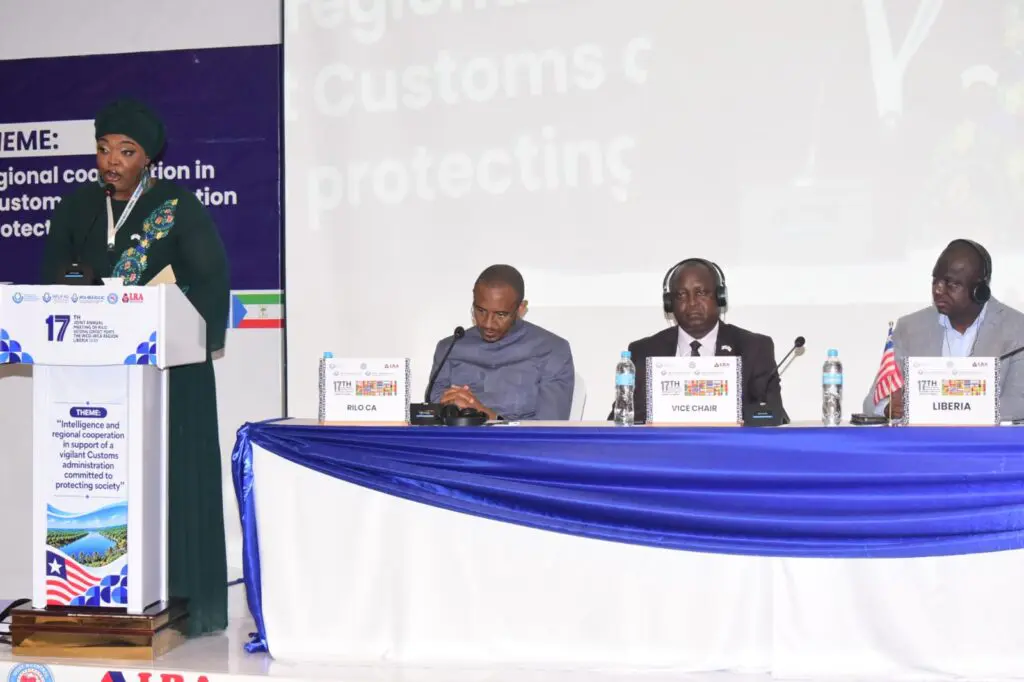
The recommendations were adopted Friday at the close of the 17th joint annual meeting of the national contact points of the World Customs Organization’s Regional Intelligence Liaison Offices for West and Central Africa. The five-day meeting was held at the Farmington Hotel in Margibi County. The recommendations now go to the region’s customs directors general for action in their own administrations.
Liberia’s commissioner of customs, Saa Saamoi, who hosted the meeting, said follow-up is the network’s weak point.
“We collect intelligence. We share intelligence. But we don’t follow up as well,” Saamoi said at the closing ceremony.
The recommendations, read in French by the meeting’s rapporteur, call on member administrations to strengthen the sanctions in national law so that illicit trafficking and illicit financial flows are punished more heavily. They also call for a share of customs offense revenue, such as fines and settlements, to fund the operations of national contact points and customs intelligence, “in a transparent framework” set by customs law.
Each administration appoints a national contact point. That officer collects, analyzes and shares enforcement intelligence with other administrations and with the two regional offices, RILO West Africa and RILO Central Africa, which coordinate joint operations.
The funding proposal addresses a problem raised when the meeting opened Monday. Ibrahim Njoya, speaking for the vice chair, told delegates then that only 17 of the region’s 24 customs administrations took part in the most recent regional enforcement operation, CRIFAX 11. He said an international operation is only as strong as its participation.
Prince B. Mulbah, deputy director general for administration of the Liberia Drug Enforcement Agency, named the region’s weaknesses at the opening as porous borders, limited forensic laboratories, delayed information sharing and corruption.
The recommendations also ask the region’s vice chair to press administrations to assign staff to the regional offices, and to promote rapid, real-time sharing of intelligence and operational information among member administrations. The regional offices are asked to expand specialized training in risk management, analysis, intelligence and targeting. They are also asked to make sure intelligence gathered in regional and international operations is systematically analyzed, shared and used to support enforcement, and to measure whether operations and training are having an effect.
National contact points are directed to send data systematically through the WCO’s national Customs Enforcement Network and its CENcomm communication platform. They must also produce annual activity reports in English and French and periodic reports to their directors general on fraud trends and new threats.
Speaking for the WCO’s vice chair for West and Central Africa, Frédéric Théodore Inamo, a representative told delegates that the threats facing customs now go well beyond collecting duties and inspecting goods. He listed customs fraud, smuggling, trafficking in narcotics, weapons and prohibited goods, money laundering, transnational organized crime and new threats tied to the shift of trade online.
“No customs administration can, on its own, effectively protect its territory without close and permanent cooperation with its counterparts,” he said in French.
Inamo, director general of customs and indirect taxes of the Central African Republic, took over the regional vice chair in September. His representative said the region’s geographic, economic and security realities demand a collective response.
“Borders must not become zones of vulnerability exploited by criminal networks, but rather zones of cooperation, vigilance and protection,” he said.
He also called for more joint operations along the continent’s main trade corridors and transit routes, and for closer partnerships with security services and regional and international bodies.
The head of RILO West Africa, Amandu Tejan Sesay, said intelligence is worth only what is done with it.
“Every piece of information we collect may offer an opportunity to prevent trafficking and protect our communities. For that opportunity to be realized, the information must be sufficiently precise, reach the right person and be acted upon in time,” Sesay said.
He urged national contact points to brief their own authorities on the meeting’s conclusions and to keep up contact between annual meetings. “The success of Monrovia is also being measured by what we do upon our return,” he said.
Saamoi said customs services face competing pressures. Governments want them to raise revenue and protect borders, society and the environment, while also speeding up trade for the private sector. He said criminal networks are outpacing the administrations pursuing them.
“The criminal networks are more advanced. They are stronger,” he said.
He said the only way customs can meet all of those demands is through proper intelligence. He also said the call to strengthen legal frameworks “is something that in my administration we take very seriously.”
The meeting was the first time Liberia has hosted the gathering. Delegates came from across both subregions. According to the organizers, participating countries included Benin, Burkina Faso, Cameroon, Cabo Verde, the Central African Republic, Chad, Côte d’Ivoire, Equatorial Guinea, Gabon, the Gambia, Ghana, Guinea, Guinea-Bissau and Liberia. Delegates from the Democratic Republic of Congo followed online because of travel restrictions.
Over the week, delegates reviewed how far last year’s recommendations from Bamako, Mali, had been carried out. They also trained on the Customs Enforcement Network and CENcomm, and heard reports from national contact points.


Discussion about this post