


Published: November 7, 2026
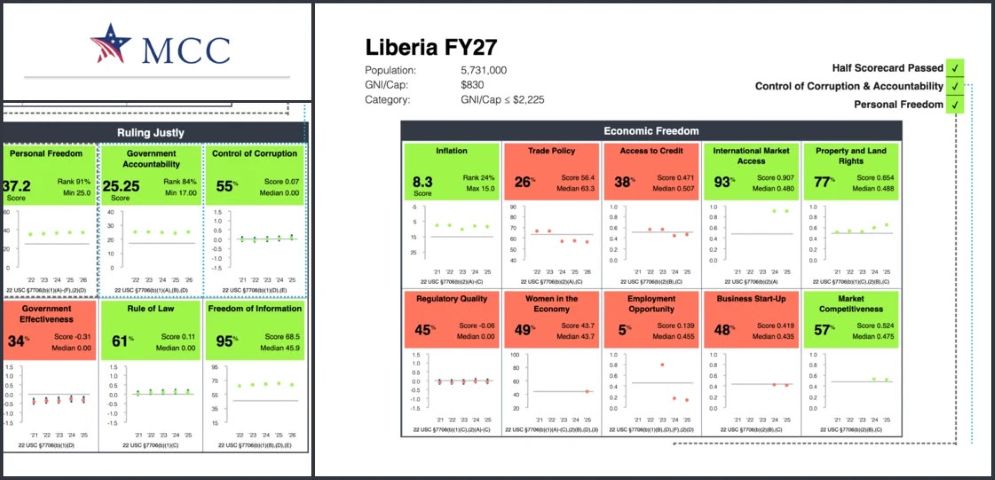
MONROVIA — Liberia has passed the Millennium Challenge Corporation’s (MCC) fiscal year 2027 scorecard, meeting all three overarching requirements despite failing 10 performance indicators covering employment opportunities, education, environmental protection, access to credit and government effectiveness.
The latest scorecard, released over the weekend by the United States government agency, shows that Liberia passed 10 of the 20 indicators with available scores, failed 10 and received no assessment for Workforce Development.
According to the report, Liberia satisfied the three overarching requirements: “Half Scorecard Passed,” “Control of Corruption & Accountability” and “Personal Freedom.”
The MCC places Liberia’s population at 5,731,000 and gross national income per capita at US$830, within the income category assessed against a threshold of US$2,225.
Under Economic Freedom, Liberia failed six of 10 indicators, including Employment Opportunity, Access to Credit, Trade Policy, Regulatory Quality, Women in the Economy and Business Start-up.
Employment Opportunity recorded the lowest relative ranking on the scorecard at 5%, with a score of 0.139 against a median benchmark of 0.455.
Access to Credit scored 0.471 against a median of 0.507, while Trade Policy registered 56.4 against 63.3.
Regulatory Quality recorded a negative score of 0.06 against a median of zero, while Business Start-up scored 0.419 against 0.435.
Women in the Economy received 43.7, equal to the displayed median, but was classified as failing on the scorecard.
However, Liberia passed International Market Access, ranking at 93%, with a score of 0.907 against a median of 0.480.
Property and Land Rights also passed, scoring 0.654 against 0.488, while Market Competitiveness recorded 0.524 against 0.475.
Inflation passed with a score of 8.3, below the maximum threshold of 15.0.
Under Investing in People, Liberia failed three indicators, passed two and received no score for Workforce Development.
Natural Resource Protection ranked at 9%, recording 24.0 against a median of 39.9.
Girls’ Primary Education Completion Rate also failed, scoring 59.0 against a median of 72.4, while Child Health registered 0.402 against 0.447.
Liberia, however, passed Health Expenditures with a score of 1.30 against a median of 0.93.
The country also passed Chronic Disease, scoring 22.0 against 23.6, an indicator for which lower scores represent better performance.
Workforce Development was marked “N/A,” indicating that no score was available.
Under Ruling Justly, Liberia passed five of six indicators, including Personal Freedom, Government Accountability, Control of Corruption, Rule of Law and Freedom of Information.
Freedom of Information recorded the country’s highest relative ranking at 95%, scoring 68.5 against a median of 45.9.
Personal Freedom ranked at 91%, with a score of 37.2 against the minimum requirement of 25.0.
Government Accountability ranked at 84%, recording 25.25 against a minimum benchmark of 17.00.
On Control of Corruption, Liberia passed with a score of 0.07 against a median of zero, placing the country at the 55th percentile.
Rule of Law also passed, scoring 0.11 against a median of zero, with a relative ranking of 61%.
However, Government Effectiveness failed, recording a negative score of 0.31 against a median of zero and ranking at 34%.
The scorecard’s historical graphs also show Liberia’s performance across previous assessment periods, including indicators measuring employment opportunities, government accountability, personal freedom and natural resource protection.




Discussion about this post