


Published: November 6, 2026

MONROVIA — The National Port Authority (NPA) has announced a series of emergency measures to ease mounting congestion at the Freeport of Monrovia, including direct vessel calls by global shipping giant Maersk, the relocation of approximately 700 long-staying containers and extended cargo clearance hours, following growing protests and complaints from Liberian businesses over prolonged shipping delays.
NPA Managing Director Sekou A. Dukuly announced the interventions Wednesday, Nov. 4, 2026, during a news conference at the Freeport, acknowledging the economic difficulties facing importers and assuring the business community that the government is taking responsibility for addressing the situation.
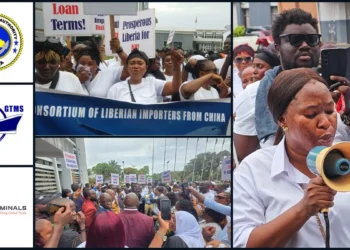
The measures come amid mounting pressure from Liberian traders, many of whom have complained about delays in receiving imported goods, increasing storage costs and financial losses, particularly as businesses prepare for the Christmas season.
Dukuly disclosed that Maersk Line has agreed to begin making direct vessel calls to the Freeport of Monrovia, eliminating the need for Liberia-bound cargo to pass through regional ports in Abidjan, Ivory Coast; Lomé, Togo; and Tema, Ghana, under the existing transshipment arrangement.
“Today, I can announce to you that Maersk Line has agreed to call the Freeport of Monrovia directly,” Dukuly declared.
He described the agreement as a significant development that could reduce shipping delays and improve the movement of goods into Liberia.
According to the NPA managing director, the authority will also temporarily suspend ongoing repairs to the port’s pier to accommodate two container vessels simultaneously, restoring some of the operational capacity lost during the rehabilitation period.
Dukuly explained that repair work over the past two months had reduced the port’s operating capacity by approximately 50%, limiting its ability to handle increased vessel traffic.
He said the NPA is coordinating with the Liberia Revenue Authority (LRA), Ministry of Commerce and Industry, commercial banks and other institutions to extend working hours and accelerate cargo clearance.
The authority is also considering additional free storage days for importers whose containers have remained at the port, a measure intended to reduce the financial burden associated with prolonged delays.
Another major intervention involves relocating approximately 700 containers that have remained at the Freeport for more than 300 days.
Dukuly disclosed that discussions are underway with the owner of an identified inland depot, where the containers would be transferred to create additional storage space.
He said the relocation exercise could begin within three to seven days, depending on the completion of the necessary arrangements.
The NPA managing director explained that removing the long-staying containers would improve available space at the port and facilitate faster handling of incoming cargo.
Addressing the causes of the congestion, Dukuly said major international shipping companies, including Maersk, Mediterranean Shipping Co. (MSC) and CMA CGM, have been operating through a regional hub system that requires Liberia-bound cargo to be transferred through larger West African ports.
He explained that the arrangement has contributed to irregular vessel arrivals, creating operational difficulties at the Freeport.
According to Dukuly, there were periods in August, September and October when only one or two vessels arrived during a week, followed by periods when five or six vessels arrived within the same timeframe.
The uneven arrivals, coupled with limited operational space and ongoing infrastructure repairs, placed additional pressure on the port’s cargo-handling capacity.
Despite identifying these challenges, Dukuly said the NPA would not shift responsibility to shipping companies or other stakeholders.
“We are not pointing fingers. We are taking responsibility. This government takes responsibility, this administration is taking responsibility,” he said.
The NPA managing director also announced that capital dredging at the Freeport is expected to begin within two to three weeks following an agreement with contractors.
He said the exercise would cover the port’s entrance channel, turning basin and other operational areas to improve navigation and accommodate larger vessels.
According to Dukuly, dredging will begin around the pilot station before extending to the container terminal and other sections of the port.
He expressed optimism that improvements in vessel access could become noticeable within 30 days of the commencement of the exercise.
Dukuly described the planned dredging as a critical intervention to address longstanding limitations affecting the country’s principal commercial seaport.
Beyond the immediate measures, he disclosed that the government is pursuing longer-term investments in port infrastructure, including the acquisition of additional cranes and other cargo-handling equipment.
He said discussions are also underway with relevant stakeholders to introduce an automated clearance system that would allow importers to process documents and make payments remotely before dispatching trucks to collect their containers.
The proposed system is intended to reduce administrative delays and improve coordination among institutions involved in cargo clearance.
Dukuly further revealed that the government is working with the NPA, APM Terminals and other stakeholders to separate general cargo operations from container handling, a move expected to improve operational efficiency.
He acknowledged that increasing commercial activity has placed additional demands on the Freeport’s existing infrastructure, underscoring the need for sustained investment and modernization.
“We understand their pain. We are also port users, so it’s not like all the congestion is benefiting us. It doesn’t benefit us. We want to see our people succeed,” Dukuly said.
He disclosed that President Joseph Nyuma Boakai has mandated relevant government institutions to take necessary steps to address the congestion and ease the financial burden on Liberian businesses.
The NPA managing director also raised the possibility of financial relief for market women and small business operators whose imported goods have been delayed.
He said the authority may engage the Central Bank of Liberia and commercial banks to explore temporarily freezing interest payments on certain loans until affected businesses recover from the disruption.
“We need to start talking to the Central Bank to intervene, or how best they can intervene on some of these market women and market men by talking to banks and seeing if some of that interest on those loans can be frozen until they can get back on their feet,” he said.



Discussion about this post