


Published: November 6, 2026
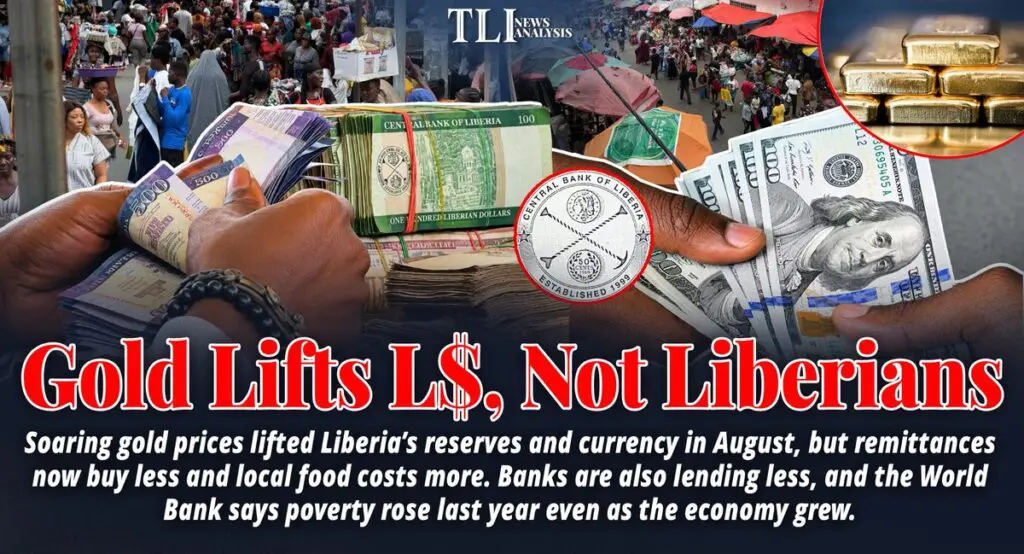
MONROVIA — A Liberian family that received US$100 from relatives abroad in August got about L$2,550 less for it than a year earlier, and the locally grown food it spent the money on cost 11.1 percent more, even as soaring gold prices strengthened the country’s reserves and its currency, Central Bank of Liberia figures show.
That disconnect sits at the center of Liberia’s economy, as outlined in the CBL’s latest Monthly Economic Review. The headline numbers are improving on the back of gold, a capital-intensive industry that employs just a few Liberians. The numbers that reach the market table, the rubber farm and the bank counter are moving in the other direction.
Start with the money sent home. The Liberian dollar closed August at L$175.60 to the U.S. dollar, against L$201.08 a year earlier, so every US$100 remitted now converts to about L$17,560 instead of L$20,108. Set against the 11.1 percent rise in the price of food grown in Liberia, that remittance buys roughly a fifth less local food than it did in August 2025. Liberians abroad sent home US$90.34 million in August alone.
“Sometimes, our relatives in America that have been helping us, they won’t understand, so, let’s take for example, when they send the school fees in U.S. dollars, when we change it to Liberian dollars, we have to add extra money there before we can pay the fees because of the U.S. rate,” said Martha Kollie, a single mother who relies on support from her brother in the United States.
She said changing U.S. dollars into Liberian dollars has become discouraging because prices remain high.
The stronger currency does help at the import counter: imported food prices rose just 1.9 percent from a year earlier. But the pressure is on the food Liberians grow and sell to one another. Domestic food inflation ran at 11.1 percent in August, against minus 1.3 percent a year earlier. Underlying inflation, which strips out food and transport, rose to 3.5 percent from 2.9 percent in July, driven primarily by restaurants, hotels and education.
Mary Subah, who sells plantain, sweet potatoes and eddoes at Red Light Market, said her sales have dropped significantly over the last three to four months. She blamed higher prices on the cost of transportation, which the CBL reported rose 7.6 percent from a year earlier.
“When people come to buy, they always complain that prices are too high. They just ask for the price and walk away. They don’t even know what it costs us to bring these good to the market,” she said.
Rubber output fell to an estimated 5,270 metric tons in August, 26.4 percent below a year earlier, even as the world rubber price was 31.1 percent higher. A better price is little comfort to a tapper with less to sell.
Gold tells the opposite story. Liberia earned US$162.76 million from gold in August, 25.7 percent more than a year earlier, even though the mines produced 14.0 percent less of it. The world price did the work, rising 31.0 percent to US$4,411 an ounce. Gold alone brought in 67.5 percent of the US$241.04 million Liberia earned from exports in the month, and gold and iron ore together accounted for 92.5 percent.
Those receipts lift the national numbers. The merchandise trade deficit narrowed to US$53.71 million from US$92.96 million in July. Gross international reserves rose to US$971.95 million, enough to cover 3.2 months of imports, and headline inflation stood at 4.6 percent.
For traders and farmers hoping to borrow, the outlook is bleaker. Total gross loans fell to L$94.08 billion at the end of August, down from L$96.18 billion a month earlier. The CBL attributed the decline primarily to reduced lending to the oil and gas and agriculture sectors. Banks are not short of cash: their liquidity ratio climbed to 58.71 percent, nearly four times the 15 percent minimum, while nonperforming loans rose to 12.32 percent of total loans, above the 10 percent ceiling.
The CBL pays an annual effective rate of 16 percent on its bills, and the stock outstanding reached L$13.71 billion at end-August. That is nearly twice the L$7.00 billion commercial banks have lent to the private sector in Liberian dollars, at an average lending rate of 12.11 percent. The CBL does not say how much of its bills the banks hold; it reports only that institutional investors took 96.7 percent of August subscriptions.
The CBL says it is anchoring inflation expectations, and inflation is lower than it was a year ago. But the arithmetic gives a lender little reason to take a chance on a rice farmer or a small manufacturer when the central bank pays more.
The World Bank’s latest Liberia Economic Update, the seventh edition, dated October 2026, puts a human cost on that split. The economy grew 5.1 percent in 2025, the bank found, yet the share of Liberians in extreme poverty rose to an estimated 36.1 percent from 34.6 percent. It blamed inflation and sluggish farm growth, the same two pressures the CBL’s August figures still show.
Mining output grew 17.0 percent in 2025, the bank said, but mining is capital-intensive and hires few people. Agriculture, which employs about 39 percent of the workforce, grew 2.6 percent, and its share of bank credit was negligible. About 78 percent of workers remain in informal self-employment or unpaid family work.
Government is not capturing the boom either. Mining revenue rose to US$141 million in 2025, the bank said, drawing on its Public Finance Review, while gold exports alone reached US$1.3 billion and iron ore US$528 million. The review estimates Liberia captures 15 to 20 percent of the fiscal value available from mining, against 50 to 60 percent in peer mineral producers.
Instead, the government balanced its books in 2025 largely by cutting investment. Capital spending fell from 8.5 percent of GDP in 2024 to 5.7 percent, the bank said, narrowing the deficit to 2.1 percent of GDP. The report called cutting the investment needed to break Liberia’s underemployment trap “precisely the wrong adjustment.”
The World Bank modeled a moderate downturn, with gold 15 percent cheaper and iron ore 20 percent cheaper, and found export earnings would fall by about US$295 million, roughly 14 percent of the total. It projects the current account deficit will widen to an average of 18.1 percent of GDP from 7.0 percent in 2025 over 2026 to 2028, as mining investment pulls in imports. August offered a preview: imports of machinery and transport equipment jumped 33.2 percent in a single month to US$124.09 million.
The bank projects poverty will fall to 33.2 percent in 2026, driven by a stronger farm sector.






Discussion about this post