


Published: November 2, 2026
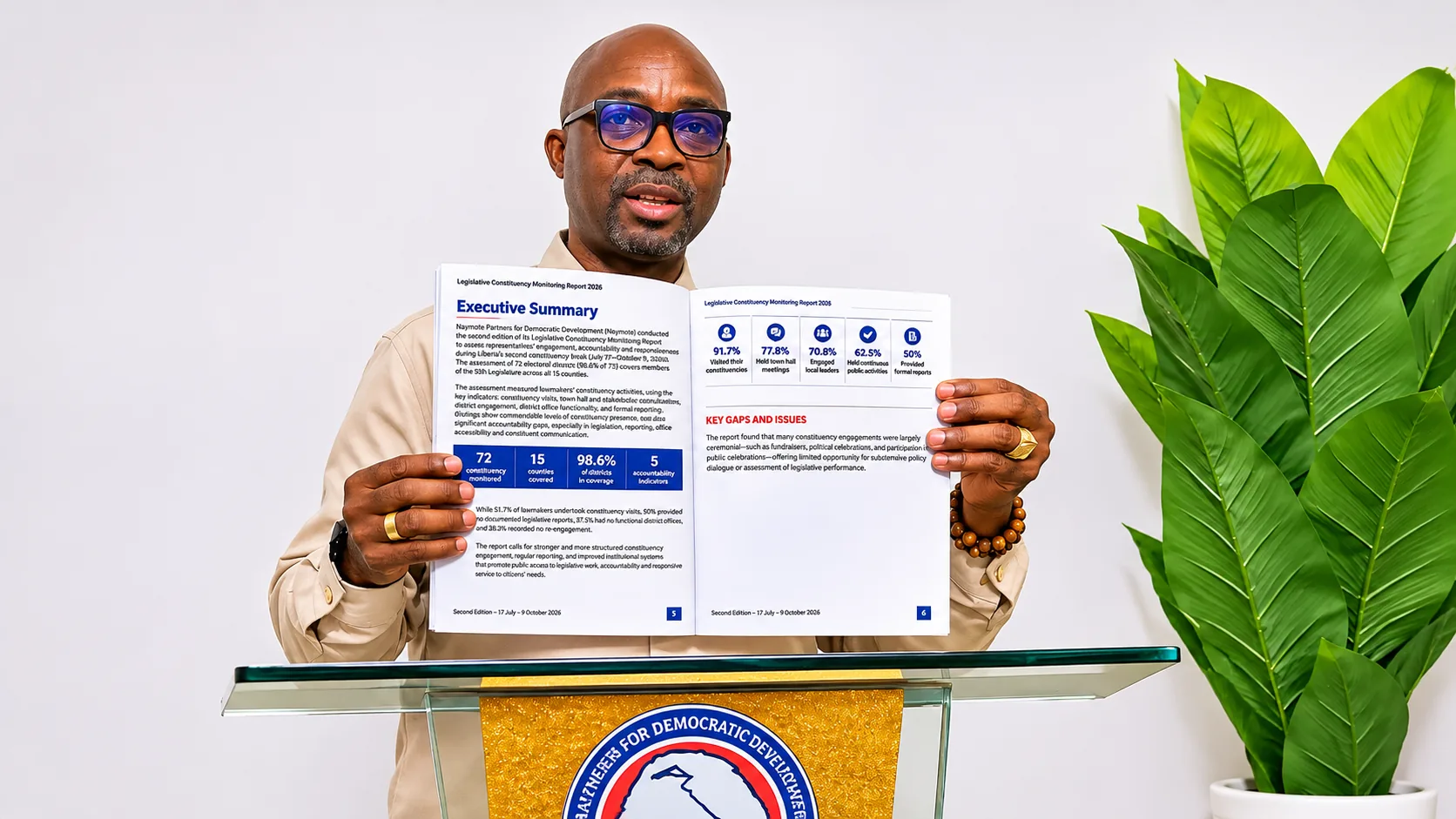
MONROVIA — A damning legislative monitoring report has exposed serious accountability gaps among members of Liberia’s House of Representatives, revealing that 36 of 72 lawmakers failed to provide documented legislative reports to their constituents, while 27 lacked functional district offices during the country’s second constituency break.
By Blamo N. Toe
The findings, released over the weekend by Naymote Partners for Democratic Development at its headquarters in Paynesville, raise questions about lawmakers’ commitment to transparency, public engagement and meaningful representation beyond ceremonial appearances and political activities.
Naymote Executive Director Eddie D. Jarwolo presented the assessment during a major press conference, highlighting the organization’s nationwide monitoring of representatives’ activities between July 17 and Oct. 9, 2026.
The organization’s second Legislative Constituency Monitoring Report covered 72 of Liberia’s 73 electoral districts across all 15 counties, representing 98.6% nationwide coverage.
According to the report, 36 lawmakers, representing 50% of those monitored, provided no documented formal legislative reports or constituency updates. Another 27, or 37.5%, had no functional district offices, limiting constituents’ access to their elected representatives.
The assessment also revealed that 21 lawmakers, representing 29.2%, recorded no media or radio engagement, while 16, or 22.2%, held no documented town hall meetings or public consultations. Six lawmakers, representing 8.3%, recorded no constituency visits during the monitoring period.
Naymote described the findings as evidence of a troubling gap between lawmakers’ public visibility and their accountability to citizens.
“Greater visibility alone does not demonstrate responsiveness or results,” the report states.
Despite the weaknesses, 66 lawmakers, or 91.7%, reportedly visited their constituencies, while 56, representing 77.8%, conducted town hall meetings or public consultations. Another 51 lawmakers, or 70.8%, participated in media and radio engagements.
However, the organization questioned whether these activities translated into substantive representation, noting that many monitored engagements centered on donations, project dedications, community ceremonies, Independence Day and Flag Day celebrations, and political networking.
“While these activities may enhance political visibility and community presence, they often offer limited opportunity for substantive policy dialogue, public scrutiny, or assessment of legislative performance and accountability,” the report states.
The findings raise concerns about representatives who maintain a visible presence at public functions but fail to establish reliable mechanisms through which citizens can question legislative decisions, track development promises or demand explanations about the use of public resources.
Naymote also identified serious weaknesses in how constituency consultations are organized. Although most monitored lawmakers reportedly conducted town hall meetings, the assessment found inconsistencies in their frequency, inclusiveness, documentation and follow-up.
“In several cases, town hall meetings lacked structured agendas and systematic mechanisms for documenting and tracking lawmakers’ commitments,” the report states.
The organization warned that these shortcomings weaken citizen participation and make it difficult to determine whether promises made during constituency engagements are fulfilled.
The absence of functional district offices was another major concern. According to Naymote, district offices should provide accessible locations where citizens can submit complaints, request information and follow up on commitments.
Of the 72 lawmakers assessed, only 45, representing 62.5%, maintained functional district offices.
The report further cautioned that the existence of a physical office does not necessarily mean it operates regularly, has adequate staffing or responds effectively to constituents.
On formal accountability, Naymote found that legislative reporting was the weakest of the five indicators assessed.
“The lack of formal reporting mechanisms limits transparency and weakens citizen oversight of elected officials,” the report states.
The organization said lawmakers should regularly explain their legislative activities, oversight interventions, constituency commitments and progress in addressing community concerns.
Beyond the numerical findings, the assessment identified poor roads, inadequate educational facilities, weak healthcare delivery, limited youth employment and community reconciliation challenges among the major concerns raised by citizens.
Naymote emphasized that addressing these issues requires substantive legislative advocacy, budget scrutiny, committee oversight and sustained engagement with responsible government institutions rather than occasional donations or political appearances.
The report also raised concerns about lawmakers claiming credit for development initiatives involving multiple institutions, noting that inadequate documentation made it difficult to distinguish legislative advocacy from projects directly implemented by government agencies or development partners.
It recommended that representatives maintain public records of commitments, clearly identify responsible institutions and provide evidence of progress.
The assessment was conducted by 72 trained monitors across Liberia’s 15 counties, using field observations, digital questionnaires and follow-up communications.
Montserrado accounted for 16 monitored districts, followed by Nimba with nine and Bong with seven. Grand Bassa, Lofa and Margibi each accounted for five districts.
Montserrado County Electoral District 10, represented by Yekeh Y. Kolubah, was excluded because of an ongoing court-related dispute involving the lawmaker and the House of Representatives. Naymote clarified that the exclusion did not constitute a judgment on the dispute.
In its recommendations, Naymote called for a fundamental shift from ceremonial constituency engagements toward documented, measurable and citizen-centered representation.
“Representatives should publish a report after each constituency break covering legislative work, oversight actions, consultations, and outstanding concerns,” the report recommends.
It also urged lawmakers to publish engagement schedules, maintain functional district offices, improve public consultations and establish transparent mechanisms for tracking constituency commitments.
The organization called on House leadership, representatives and civil society groups to develop common accountability standards and strengthen independent monitoring.






Discussion about this post