

Published: October 26, 2026
MONROVIA — United Nations officials have urged Liberia to build on more than two decades of peace by strengthening women’s participation in national development, expanding education and employment opportunities for young people, and improving healthcare delivery as the country prepares to assume its responsibilities on the United Nations Security Council.
By Roseline Gbessagee
The officials said Liberia’s transition from a country recovering from civil conflict to a participant in global peace and security decisions presents an opportunity to advance domestic development priorities while strengthening its international partnerships.
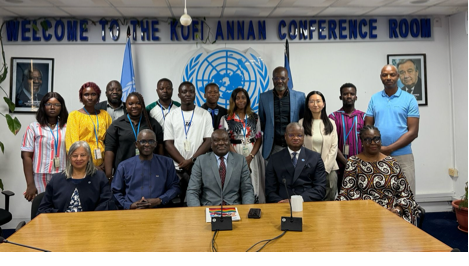
They spoke Friday, Oct. 23, during a joint government-UN media briefing at One UN House in Monrovia ahead of the 2026 United Nations Day commemoration.
The commemoration, scheduled to be hosted at the Ministry of Foreign Affairs, is being held under the theme, “Liberia in UN Security Council: From Sustaining Peace at Home to Advancing Peace and Security Globally.”
United Nations Resident Coordinator in Liberia Christine N. Umutoni said the government’s decision to host the event at the Ministry of Foreign Affairs demonstrates the partnership between Liberia and the United Nations.
According to her, although Liberia has hosted previous UN Day celebrations, this year’s commemoration will be the first held at the ministry.
“It is a strong communication of partnership,” Umutoni said.
She noted that the celebration comes as Liberia prepares to chair the UN Security Council, providing an opportunity for the government to outline its diplomatic priorities and roadmap for the chairmanship.
“What I already know from hearing past speeches from the President is that the label reads Liberia, but the seat belongs to Africa. So, it is a voice, an African voice at the table,” she said.
Umutoni described Liberia’s election to the Security Council as recognition of its experience in recovering from conflict and maintaining peace.
“Liberia deserves to talk about peace and security because they know what it means. Liberia deserves it. They’ve gone through, they’ve demonstrated. Over 20 years of peace is an example,” she said.
She said Liberia’s participation in the council represents a transition from receiving international peacebuilding assistance to contributing to decisions on global peace and security.
According to the resident coordinator, the country’s experience provides lessons for other nations confronting conflict and offers opportunities to strengthen diplomatic relations, attract investment and expand development partnerships.
Umutoni urged Liberia to sustain its peace gains while addressing challenges that could undermine national stability.
“Once you’ve demonstrated peace, you’ve been an example, you’re sitting up there, you cannot backslide. You cannot go back,” she said.
She emphasized that Liberia’s participation in the Security Council should also demonstrate the relationship between peace, economic development and improved living conditions.
Beyond peace and security, other UN officials outlined ongoing interventions in education, healthcare, technical training and women’s empowerment, highlighting areas requiring continued government and development partner collaboration.
Michael N’Gussan, head of health supply chain at the World Food Programme (WFP), disclosed that the organization provided approximately 9 million meals to schoolchildren across Liberia in 2025, reaching about 79,000 beneficiaries.
He said the school-feeding program was intended to improve school attendance while supporting local agricultural production through the purchase of food from Liberian farmers.
“Roughly around 16,000 farmers were supported as we were procuring the food locally,” N’Gussan said.
He also highlighted WFP’s support for Liberia’s healthcare system, particularly its collaboration with the Ministry of Health in managing the country’s Central Medical Store.
According to him, WFP distributed approximately US$20 million worth of medical commodities across Liberia’s 15 counties in 2025.
He said the intervention was designed to strengthen the Ministry of Health’s capacity to manage medical supplies and improve the distribution of essential health commodities nationwide.
On youth employment and technical education, Chie Matsumoto, an industrial development officer at the United Nations Industrial Development Organization (UNIDO), said the agency is working with the ministries of Education and Youth and Sports to strengthen Liberia’s technical and vocational education and training system.
She disclosed that UNIDO is supporting 20 institutions across the country’s 15 counties through policy development, governance reforms and institutional assistance.
Matsumoto emphasized the importance of connecting basic education with technical and vocational training to equip young Liberians with skills needed for employment and entrepreneurship.
She said UNIDO has also begun implementing science, technology, engineering and mathematics education initiatives in high schools to prepare students for emerging employment opportunities.
Recognizing the limited availability of formal jobs, Matsumoto stressed the need to strengthen entrepreneurship and practical skills development.
She also disclosed that UNIDO is collaborating with the United Nations Educational, Scientific and Cultural Organization (UNESCO) on a recognition-of-prior-learning initiative to help individuals obtain formal recognition for skills acquired outside traditional educational institutions.
On digital education, Matsumoto said UNIDO is piloting an electronic learning platform for technical and vocational institutions.
She explained that the platform is being developed to address Liberia’s electricity challenges and reduce operating costs through open-source technology and offline accessibility.
According to her, the agency intends to expand the initiative nationally if the pilot proves successful.
Meanwhile, UNICEF Representative in Liberia Shairose Mawji called for greater investment in foundational education, particularly reading and writing, to improve children’s prospects for advanced learning and future employment.
She said UNICEF and other development partners are working with the Ministry of Education to strengthen essential learning competencies that would enable students to progress into digital literacy, technical training and entrepreneurship.
Mawji emphasized that education policies must respond to labor-market demands rather than focus exclusively on classroom instruction.
“This means strengthening the education components, looking at the labour-market needs, and ensuring that there is a pathway,” she said.
She called for coordinated efforts involving the government, private sector, UN agencies, nongovernmental organizations and development partners to establish clear pathways from education to skills training and employment.
Mawji said such collaboration would help ensure that young Liberians acquire practical skills relevant to available economic opportunities.
Turning to women’s leadership, UN Women Liberia Deputy Country Representative Dr. Yemi Fulayajo called for greater recognition of Liberian women’s contributions to peacebuilding and increased opportunities for them to influence national development policies.
She said Liberian women played significant roles in ending the country’s civil conflict and have continued contributing to peacebuilding efforts beyond Liberia.
“We’re very proud of them. You know, they’ve gone from peace activists, just seeing their sons and their daughters and their husbands and their brothers die, to now global peace builders,” Fulayajo said.
She stressed that Liberia’s peacebuilding record should not overshadow the contributions of women who participated in reconciliation and conflict-resolution efforts.
Fulayajo also highlighted Liberia’s role in advancing the Women, Peace and Security agenda, describing the country as the first post-conflict nation to develop such an agenda.
She said Liberia’s presence on the Security Council provides an opportunity to promote women’s participation in international peace and security discussions while expanding their influence in domestic governance.
“We must empower women’s voices to lead in the development agenda as well, not just conflict and peacebuilding, not only when there is a crisis,” she said.
Fulayajo argued that women should participate more actively in economic policymaking, resource allocation and leadership decisions that affect national development.
She also identified financial technology and artificial intelligence as potential tools for expanding women’s economic opportunities and reducing inequalities.
However, she said access to technology alone would not be sufficient without improvements in women’s education, economic empowerment and participation in decision-making.
Fulayajo called for policies and institutional support that would enable women to contribute meaningfully to Liberia’s economic and social development.
“If women can navigate peace, then they can also navigate development,” she said.



Discussion about this post