

Published: October 19, 2026
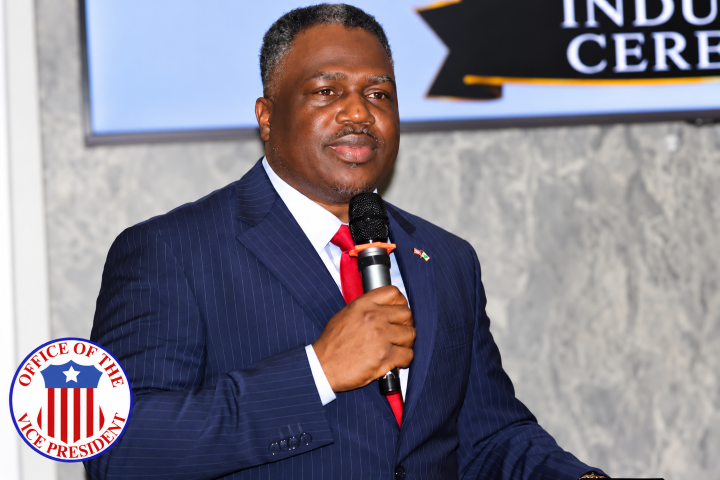
MONROVIA — Vice President Jeremiah Kpan Koung has challenged African leaders to end the continent’s overdependence on raw mineral exports and pursue a coordinated industrialization strategy that transforms Africa’s vast mineral wealth into jobs, manufacturing industries, infrastructure and sustainable economic growth.
Speaking on behalf of President Joseph Nyuma Boakai at the Africa Minerals Policy Forum — Mining in Motion 2026 in Accra, Ghana, on Monday, Oct. 19, Koung outlined five priorities for transforming Africa’s mining sector, emphasizing local mineral processing, stronger regulatory institutions, community benefits, responsible small-scale mining and fair investment partnerships.
Addressing the forum under the theme, “One Continent, One Policy – Aligning Africa’s Mineral Future,” the Liberian vice president warned that Africa continues to lose significant economic opportunities because much of the value generated from its mineral resources is captured outside the continent.
“Our theme, ‘One Continent, One Policy – Aligning Africa’s Mineral Future’, asks us to confront a familiar contradiction: Africa possesses immense mineral wealth, yet too many of our people see little lasting benefit from its extraction,” Koung said.
He argued that Africa’s longstanding reliance on exporting raw or minimally processed minerals has allowed other countries to benefit disproportionately from skilled employment, advanced technologies, manufacturing and commercial profits.
According to Koung, the growing global demand for minerals used in renewable energy systems, digital technologies and manufacturing presents an opportunity for African countries to strengthen their industrial capacity and secure greater economic returns.
“The question is how we turn that wealth into productive industries, decent jobs, reliable infrastructure and better lives,” Koung asked. “The growing demand for minerals used in energy systems, digital technologies and manufacturing gives us an opportunity to do so. We must approach it with clear priorities and stronger cooperation”.
The vice president maintained that African countries must pursue common policy objectives without compromising national sovereignty, environmental safeguards or their legitimate share of mining revenues.
He cautioned that governments should not weaken regulations or surrender reasonable revenues simply to attract foreign investment.
Koung said the Africa Mining Vision provides an existing framework for connecting mineral development to energy, transportation, agriculture, manufacturing, skills development and technological advancement.
However, he emphasized that the continent must move beyond policy declarations toward practical investments and measurable outcomes.
“Allow me to highlight five priorities. First, we must build African value chains supported by dependable energy and infrastructure. Processing and manufacturing require affordable electricity, efficient transport, ports, skilled workers, and access to markets. A mineral deposit alone cannot sustain an industry,” the vice president indicated.
Koung explained that mineral processing facilities cannot operate competitively without dependable electricity, modern transportation networks, efficient ports, skilled labor and access to regional and international markets.
He urged governments to coordinate mining-related infrastructure investments so that electricity and transportation projects also benefit households, local businesses and other productive sectors.
The vice president identified regional cooperation as critical to achieving industrial development, noting that African countries possess complementary resources and capabilities.
He said one country could supply minerals while another provides electricity, processing facilities or access to markets.
According to him, the African Continental Free Trade Area offers an opportunity to connect these resources through coordinated regional investments and industrial projects.
Turning to his second priority, Koung called for stronger geological knowledge, capable public institutions and transparent mineral licensing systems to improve Africa’s negotiating position.
“Second, we must strengthen geological knowledge and public institutions,” the vice president said. “Governments need reliable information about the resources they manage to value concessions and negotiate sound agreements. Geological surveys, laboratories and secure digital information systems are essential investments”.
He stressed that governments must possess reliable geological information before negotiating mineral concessions with foreign investors.
Koung also advocated transparent revenue management, effective regulatory institutions and cooperation on taxation, beneficial ownership, local content requirements and mineral resource reporting.
He said African countries should develop compatible standards for geological data management and mineral classification to strengthen their bargaining power and reduce harmful competition for investments.
“Africa must understand the value of what it possesses before negotiating the terms of its development,” Koung declared.
On his third priority, the vice president urged governments to make tangible benefits for mining communities a central measure of success.
He said communities affected by mining operations must participate meaningfully in decisions involving their land, livelihoods and natural resources.
Koung emphasized that mining agreements should provide fair compensation, employment opportunities, local procurement, environmental protection and access to essential public services.
He further called for mine closure and livelihood restoration plans to be developed and adequately funded from the beginning of mining operations.
According to him, women, young people and persons with disabilities must also have equitable access to employment, training and business opportunities arising from mineral development.
The vice president maintained that mining communities should continue benefiting from infrastructure and alternative economic opportunities long after commercial extraction ends.
His fourth priority focused on strengthening artisanal and small-scale mining, which provides livelihoods for thousands of families across the continent.
“Fourth, we must support responsible artisanal and small-scale mining,” he said. “Many families depend on this sector. Accessible licensing, technical assistance, safer methods, finance and legitimate markets can improve livelihoods and strengthen traceability. These efforts must accompany firm action against smuggling, child labor and criminal exploitation”.
Koung urged African governments to simplify licensing procedures, improve access to financing and technical assistance, and establish legitimate markets for small-scale miners.
He also called for stronger measures against mineral smuggling, child labor and criminal exploitation within the sector.
On his fifth priority, Koung challenged African governments to pursue fair investment partnerships backed by transparent agreements, technology transfer and measurable economic benefits.
“Fifth, we must pursue fair partnerships and accountable implementation,” Koung said. “Our partnerships should be assessed by the skills transferred, businesses developed, industries established and public value created, alongside production and export revenues”.
The vice president maintained that African countries should evaluate mining investments not only by production levels and export earnings but also by their contributions to local businesses, industrial development, employment and public revenue.
He urged African leaders to engage international partners on the basis of fairness, transparency and respect for national sovereignty.
“We should welcome mutually beneficial cooperation without allowing our continent to become an arena for geopolitical rivalry,” Koung cautioned.
He identified the Africa Minerals Strategy Group, African Union, African Minerals Development Center and regional institutions as important partners in coordinating mineral policies and monitoring implementation.
Koung also used the occasion to outline Liberia’s mineral development priorities under President Boakai’s ARREST Agenda for Inclusive Development.
He said the administration intends to strengthen geological information systems, modernize mineral licensing procedures, improve revenue transparency and increase local participation in mining-related businesses.
“Under President Boakai’s ARREST Agenda for Inclusive Development, we seek to make mineral resources a foundation for economic diversification, infrastructure and improved public services,” Koung said.
“Our priorities include better geological information, modern licensing and cadastre systems, transparent revenues, stronger local procurement and greater domestic value addition. We also seek safer artisanal mining, stronger environmental management and sustainable livelihoods for mining communities,” Koung added.
The vice president further emphasized Liberia’s commitment to responsible mine closure and the development of alternative livelihoods for communities that depend on mineral extraction.
He said planning for the economic future of mining communities must begin while mines remain operational and continue generating revenue.
Koung also expressed Liberia’s readiness to cooperate with neighboring countries through the Mano River Union, the Economic Community of West African States and continental institutions to develop shared infrastructure and regional processing industries.
Moving beyond the five priorities, Koung proposed several measures intended to produce practical outcomes from the Accra forum.
He called for a common African mineral policy compact establishing shared principles for responsible mineral development and a regional value-addition roadmap identifying priority processing and manufacturing projects.
The vice president also proposed stronger cooperation on geological information, local content requirements and technology transfer, supported by financing arrangements for viable regional projects.
Other proposals included coordinated action against illicit mineral trading and financial flows, alongside annual ministerial reviews to assess progress.
“An annual review should be supported by a transparent performance dashboard covering project preparation, investment, local procurement, skills development and community outcomes,” he stressed. “Comparable information would help us identify delays, learn from successful approaches and direct political attention to obstacles that require collective action”.
Koung maintained that stronger cooperation and transparent monitoring would help African countries translate mineral policy commitments into investments, industries and lasting improvements in citizens’ lives.
He concluded by reminding African leaders that the continent’s mineral resources belong not only to the present generation but also to future generations.
“Our success will be measured in the opportunities it creates for our people and the strength of the communities and institutions it leaves behind,” Koung stated.

Discussion about this post