

Published: October 19, 2026
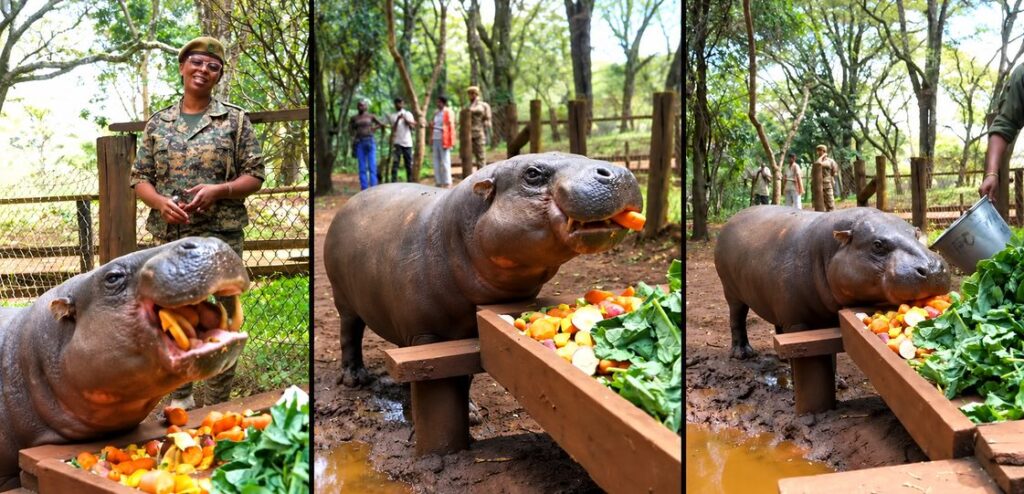
MONROVIA — Somewhere in Nairobi lives a 24-year-old with deep Liberian roots, a sweet-potato weakness, and a habit of posing for photographs with strangers. He has never set foot in Liberia. He is also a pygmy hippopotamus, a rare species found only in Liberia.
By Lennart Dodoo
His name is Bob. According to the Kenya Wildlife Service, he is the grandson of two pygmy hippos that President William V.S. Tubman gave to Kenya’s founding president, Jomo Kenyatta, in 1970.
The Liberian Investigator learned about Bob’s story from a reel the Kenya Wildlife Service posted on Facebook. In it, a keeper at the Nairobi Safari Walk walks viewers through a family history that begins with Liberian diplomacy and ends with a very large salad.
The service said Tubman traveled to Kenya in 1970 as a guest of honor at the Nairobi show of the Agricultural Society of Kenya. He did not arrive empty-handed. He brought two pygmy hippos, which is the kind of gift that settles the question of who wins at state visits.
The female was named Elizabeth. The male, history records, was not named at all.
“The female was christened as Elizabeth. Unfortunately, the male was not christened,” the keeper said in the reel.
Whatever the nameless male lacked in title, he made up for in family. The pair settled at the Nairobi Animal Orphanage, on the site where the Nairobi Safari Walk now stands, and produced “many offsprings,” the keeper said.
In 1997, when construction of the Safari Walk began, the hippos, along with other exotic animals, were moved to the Ol Jogi Conservancy and the Mount Kenya Wildlife Conservancy. Bob was born at Ol Jogi around 2002, the service believes. In 2004, when the Safari Walk ended, Elizabeth returned to Nairobi with her grandson, then about 2 years old.
Elizabeth died in 2011 at age 40, when Bob was about 9. Today, he is Kenya’s only pygmy hippo, according to the service.
He is not starving for attention or for food. Bob eats 18 kilograms of food a day, the keeper said: carrots, sweet potatoes, French beans, kale and cabbage, plus supplements. In Monrovia terms, that is a good morning’s worth of greens from Duala Market, eaten in one sitting by one customer who does not pay.
He is also, by all accounts, a gentleman. The keeper described him strolling the edge of his enclosure, where visitors can photograph him up close.
“He’s a calm animal who just walks calmly, just looking at the visitors and most of the time posing for photos,” the keeper said.
Families who first saw Bob years ago now bring their own children back to meet him, the keeper said. For a Liberian whose grandparents arrived as a diplomatic present, that is a respectable career in public relations.
Bob’s story lands differently at home, because the pygmy hippo is, in a real sense, Liberia’s animal. Its scientific name, Choeropsis liberiensis, refers to Liberia, where scientists first documented the species. Most of the world’s wild pygmy hippos live in Liberia’s forests, with smaller numbers in Sierra Leone, Guinea and Ivory Coast.
The species is in trouble. The International Union for Conservation of Nature lists it as endangered, with fewer than 2,500 left in the wild, according to its 2015 assessment. In Liberia, the animals face illegal hunting for bushmeat and the loss of the forests and wetlands they depend on.
“You realize that with the loss of the tropical forests, we are losing the wetlands. And so the population of the pygmy hippos is declining with time,” the keeper said.
The animals are shy, nocturnal and mostly solitary, which makes them hard to see in the wild. That may explain why many Liberians have never seen one. Bob, meanwhile, poses for tourists daily, 4,000 miles away. A pygmy hippo in Thailand, Moo Deng, became a worldwide internet sensation in 2024. Bob, who has been doing the same job quietly for two decades, may have a grievance.
The Kenya Wildlife Service calls Bob “a living link to our history and a testament to the long-standing bond between nations committed to wildlife.” It is asking the public for donations toward his specialized care, feeding, habitat enrichment and conservation education.
Tubman died the year after his Nairobi visit. His hippo diplomacy outlived him by more than half a century, and it is still drawing crowds.





Discussion about this post