

Published: October 19, 2026
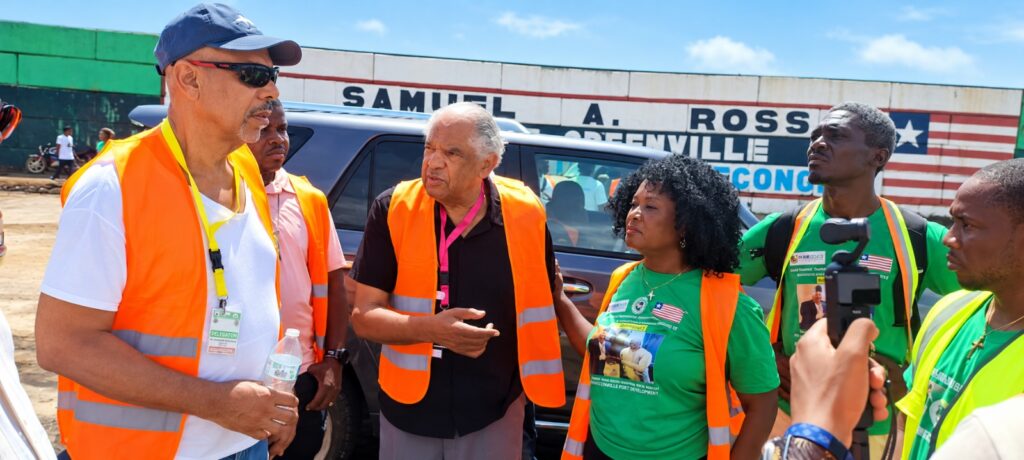
GREENVILLE, Sinoe County — The Samuel Alfred Ross Port of Greenville could provide about US$500,000 in equipment to the Samuel Alfred Ross Port of Greenville, as a five-member Maryland delegation begins a 15-day assessment of the port and surrounding communities’ needs.
By Blamo N. Toe
Maryland has already identified the equipment for donation, but delivery depends on the delegation’s findings, confirmation of equipment specifications, and final logistics. The assessment covers the port’s infrastructure, cargo handling, technology, energy, and emergency response, as well as roads, health care, women’s farming, and youth programs in nearby communities.
The visit grew out of an appeal by Cllr. Sylvia Tarley, the port’s executive director. While on annual leave in the United States in July 2026, she asked the Maryland governor’s office for help rehabilitating and modernizing a facility she said had suffered eight years of neglect.
Maryland responded by establishing the Maryland-Liberia Sister-State Joint Infrastructure and Capacity Building Planning Committee under a memorandum of understanding signed in June 2026 and by arranging the working visit.
The committee’s chairman, former Maryland state Sen. Michael Bowen Mitchell, is leading the delegation. Mitchell, a lawyer, also serves on the board of Sister States of Maryland and is vice chair of the Maryland-South Africa Committee.
With him are Tolutope Adeyoju, Maryland’s commissioner for African affairs; James Rose Jr., a specialist in longshore work and port and marine operations; Marcus Lorick, a specialist in information technology and solar systems; and Lt. Shana Alexandria Haughton, a specialist in firefighting, safety and emergency medical services.
The delegation met President Joseph Nyuma Boakai in Washington on Sept. 18 and arrived in Liberia on Oct. 11. On Oct. 13 it held talks with National Port Authority Managing Director Sekou A.M. Dukuly and senior managers at the Freeport of Monrovia, then traveled to Greenville on Oct. 15.
A central part of the assessment is determining whether the cranes, heavy machinery, and cargo-handling equipment on offer will work at Greenville. The team will examine soil-bearing capacity, quayside depth, salinity, and existing foundations, and verify technical specifications before anything is shipped to reduce the risk of delivering equipment the port cannot use.
The delegation will also review port management software, automated logistics systems and maintenance arrangements, and ways to speed up cargo handling, cut vessel turnaround times and increase the port’s revenue.
Beyond the port, the team will assess needs in Dioh Town, Teah Town and Seebeh, communities affected by port operations, along with roads in Greenville and routes leading to the port.
The National Port Authority, meanwhile, laid out longer-term plans for the facility. Mulbah G. Hwesa, the authority’s executive director for ports and harbors, said the port’s master plan sets aside space for a breakbulk terminal for general cargo, for bulk cargo operations depending on demand, and for two additional piers.
“So when you look at our master plan, our master plan says that it’s protected,” Hwesa said.
He said the port’s future could hinge on whether iron ore mining resumes at Putu in Grand Gedeh County. Pointing to the existing pier, he said, “If you start to mine iron ore, you cannot be shipping iron ore from here.” Indicating another section of the port, he added, “You can use this facility.”
Mineral exports would require specialized loading facilities, transport links and supporting infrastructure, Hwesa said.
No agreement has been announced tying the Maryland equipment to specific projects in the port’s master plan. The committee is expected to use the delegation’s findings to decide what equipment and resources to provide, and what further help can be mobilized for surrounding communities.





Discussion about this post