


Published: October 14, 2026
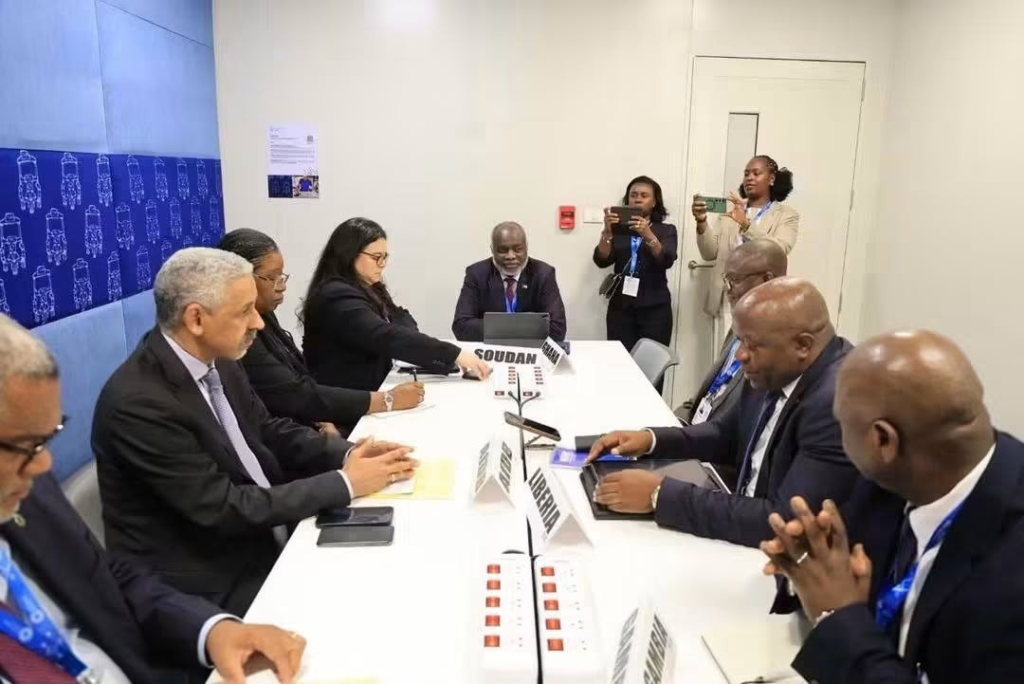
BANGKOK, Thailand — African Development Bank (AfDB) President Dr. Sidi Ould Tah has reaffirmed the Bank’s commitment to financing critical infrastructure, energy, agriculture and other development projects across Africa, as Liberia’s Finance and Development Planning Minister Augustine Kpehe Ngafuan outlined the country’s economic gains and pushed for sustained investment in projects intended to accelerate growth, create jobs and strengthen regional trade.
By Masefane Konneh
The commitment came during a meeting Tuesday, Oct. 13, between Ould Tah and finance ministers representing AfDB Constituency 15 on the sidelines of the International Monetary Fund (IMF) and World Bank Annual Meetings in Bangkok, Thailand.
The discussions focused on economic developments in member countries, the Bank’s financing capacity, and efforts to expand investments in infrastructure and other sectors essential to Africa’s economic transformation.
Ould Tah commended the ministers for their continued support of the Bank and efforts to strengthen their respective economies, identifying Liberia as one of Africa’s leading economic performers.
He also recognized Constituency 15 as the first to contribute to the AfDB Fund, with Liberia committing US$3 million.
According to a release on the meeting, the AfDB president disclosed that the institution was pursuing initiatives to strengthen its lending capacity by mobilizing additional resources through international capital markets.
The initiative is intended to increase the financing available to African countries for infrastructure, agriculture, energy and other development priorities.
Ngafuan, who chairs Constituency 15, welcomed Ould Tah’s leadership and commended his efforts to reduce bureaucratic delays, strengthen member countries’ representation and expand infrastructure financing.
The Liberian finance minister used the engagement to present an overview of Liberia’s economic performance, highlighting improvements in growth, inflation, public debt management and fiscal performance.
According to figures presented by Ngafuan, Liberia’s economy expanded by 5.1% in 2025, compared with 4% in 2024, and is projected to grow by 5.5% in 2026.
He reported that inflation declined from 12.5% in early 2025 to 4.3% at the end of September 2026, while the country’s debt-to-gross domestic product ratio dropped from 55.6% in 2024 to 54.1% in 2025.
The ratio is projected to decline further to 49.6% in 2026.
Ngafuan also disclosed that Liberia exceeded its fiscal target under its IMF-supported program in 2025, describing the performance as part of the government’s efforts to strengthen fiscal management and maintain economic stability.
Despite the reported improvements, the minister emphasized the importance of continued development financing to sustain growth, improve domestic revenue generation and create economic opportunities, particularly for young people.
During the discussions, Ngafuan identified three major AfDB-supported initiatives as critical to Liberia’s development agenda: the Domestic Resource Mobilization Project, the Youth Entrepreneurship Investment Bank (YEIB) and the Cavalla River Bridge.
The Domestic Resource Mobilization Project seeks to strengthen Liberia’s revenue collection capacity, particularly within the mining sector, which remains a major contributor to the country’s economy.
The initiative is designed to improve the government’s ability to collect revenue from natural resources and increase funding available for public services, infrastructure and other national development priorities.
Strengthening domestic revenue collection is also expected to support the government’s efforts to reduce reliance on borrowing to finance development projects.
Ngafuan further highlighted the Youth Entrepreneurship Investment Bank, an initiative intended to expand access to financing, mentorship and business development opportunities for young Liberians.
Launched in July 2025, the initiative made Liberia the first African country to operationalize the AfDB’s youth investment bank model.
The program is designed to support young entrepreneurs through access to capital, technical assistance and skills development, with a target of creating up to 120,000 jobs.
The initiative forms part of broader efforts to address limited access to financing and employment opportunities among young people by supporting the establishment and expansion of youth-led businesses.
The finance minister also highlighted the Cavalla River Bridge, a 288-meter crossing connecting Liberia and neighboring Côte d’Ivoire under the Mano River Union road program.
The bridge is expected to improve cross-border transportation, facilitate trade and strengthen economic cooperation between the two countries.
Upon completion, the project is expected to replace existing ferry and canoe crossings, reduce transportation costs and improve the movement of people and goods along the border.
Ngafuan, however, acknowledged delays in the bridge’s construction and urged the parties involved to intensify efforts to ensure its completion by March 2028.
The project is among the regional infrastructure initiatives intended to improve connectivity and promote trade among Mano River Union countries.
AfDB Constituency 15 comprises Liberia, The Gambia, Ghana, Sierra Leone and Sudan. The constituency provides a platform for member countries to engage the Bank on financing priorities, economic policies, and development challenges.
Ngafuan was joined at the meeting by The Gambia’s Seedy K.M. Keita, Sierra Leone’s Karefa Ansumana Francis Kargbo and Sudan’s Dr. Jibril Ibrahim.



Discussion about this post