


Published: October 14, 2026
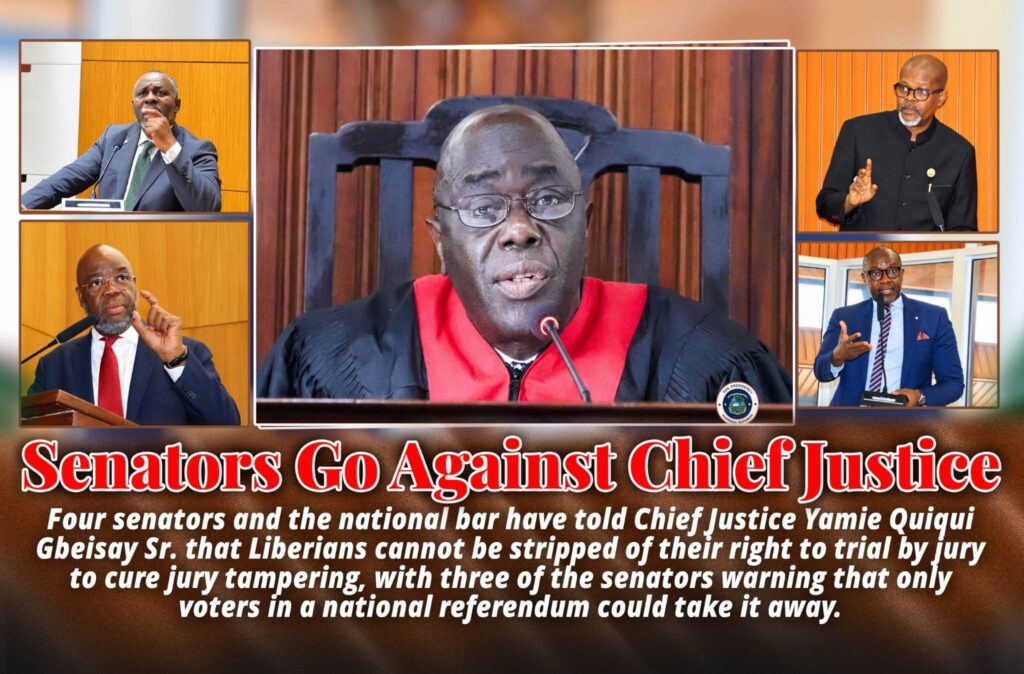
MONROVIA – Chief Justice Yamie Quiqui Gbeisay Sr.’s call to reconsider trial by jury amid a string of alleged jury-tampering cases has drawn opposition from four senators and the Liberia National Bar Association, with three senators warning that Liberians cannot lose the right without a national referendum.
By Blamo N. Toe & Masefane Konneh
The 1986 Constitution guarantees the right in Article 20(a). Under Article 91, which the senators cited, removing it would require a two-thirds vote in both houses of the Legislature, followed by ratification by two-thirds of registered voters in a referendum held no sooner than one year after the Legislature acts.
Gbeisay opened the Supreme Court’s October Term on Monday by warning that bribery, threats and undue influence on jurors were undermining justice and eroding public confidence in the courts.
“A corrupt jury is worse than no jury at all,” he said.
He cited alleged jury interference in Nimba, Grand Gedeh, Bomi and Margibi counties and at Criminal Court “C” in Montserrado County, and called on the Legislature, the bar, the Law Reform Commission and other stakeholders to consider the future of trial by jury.
Montserrado County Sen. Abraham Darius Dillon, Gbarpolu County Sen. Amara M. Konneh and Bomi County Sen. Edwin Melvin Snowe each said the right could not be removed without a constitutional amendment. Margibi County Sen. Nathaniel F. McGill said abolition could prove difficult because of the amendment requirements and called instead for reform of the jury law.
“Besides, Mr. Chief Justice, your reason for suggesting ‘dissolution’ of the fundamental right to ‘trial by jury’ does not, in my view, present a strong case to even justify or warrant a referendum for said purpose,” Dillon said.
Dillon said jury tampering exposes weaknesses in the justice system and raises questions about the judiciary’s ability to investigate and punish those responsible. He likened abolition to burning down a house to get rid of a rat.
Konneh said bribed or tampered juries can produce acquittals that contradict the evidence, but he rejected abolition.
“But abolishing jury trials is not the answer. Before it is a policy question, it is a constitutional question,” Konneh said.
“The people must consent to removing their own right. That is the point,” he said.
Snowe, in a response titled “Reform the Jury System, Protect the Constitution, and Strengthen Justice,” drew a line between an accused person choosing to waive a jury and the state abolishing the right for everyone.
“A corrupt jury is worse than no jury at all.”
Chief Justice Yamie Quiqui Gbeisay Sr.
“Corruption demands investigation, accountability, and institutional repair. Its existence does not, by itself, justify withdrawing a fundamental right from the Liberian people,” Snowe said.
The cases Gbeisay cited stretch back four years. In 2022, in Nimba County’s Eighth Judicial Circuit, a deputy marshal was allegedly used as a conduit to compromise a jury. In Republic of Liberia v. David Nagbe, a rape case heard during the May 2025 term in Grand Gedeh County, alleged jury interference came to light four days after an acquittal. In Republic of Liberia v. George Bongar, heard during the May 2026 term in Bomi County, suspected tampering surfaced 19 days after an acquittal.
In Margibi County, suspected interference was detected while the drug case Republic of Liberia v. Quita Dolo et al. was still underway. At Criminal Court “C” in Monrovia, alleged jury manipulation led to the termination of proceedings in a US$100,000 drug-related case. In a separate matter, Judge Ousman F. Fieka’s investigation found gross jury tampering after allegations emerged seven days after an acquittal, Gbeisay said.
Rather than scrapping juries, Konneh proposed mandatory sequestration and anonymity for jurors in serious criminal cases, improved pay and protection for jurors, a transparent, professionally managed selection system, and prosecution of jury tampering as a standalone offense with mandatory custodial sentences. He urged Gbeisay to send a comprehensive Jury Reform Act to the Legislature for public hearings.
McGill said he believed the chief justice was motivated by concern about systemic corruption in the judiciary.
“Therefore, the Legislature, the Liberia National Bar Association, and civil society organizations should work together to reform the existing jury law to ensure transparency, accountability, and fairness,” McGill said.
The bar condemned jury tampering but said its willingness to join Gbeisay’s consultations did not constitute support for abolition. LNBA President Cllr. Juah Lawson said that anyone who bribes jurors, tries to influence them, or brokers corrupt arrangements undermines the justice system.
“Such conduct must have consequences,” Lawson said.
“The LNBA accepts the invitation to participate in this intervention,” Lawson said. “However, our participation should not be understood as an endorsement of abolition.”
“Before we contemplate abandoning the institution itself, we should carefully examine why there is failure in particular instances and whether those failures may be corrected,” Lawson said.
Konneh left the door open only as a last resort.
“Let us fix the system together. If reform ultimately fails, the constitutional amendment process exists for exactly that reason. But abolition cannot be our first answer,” he said.





Discussion about this post