


Published: October 13, 2026
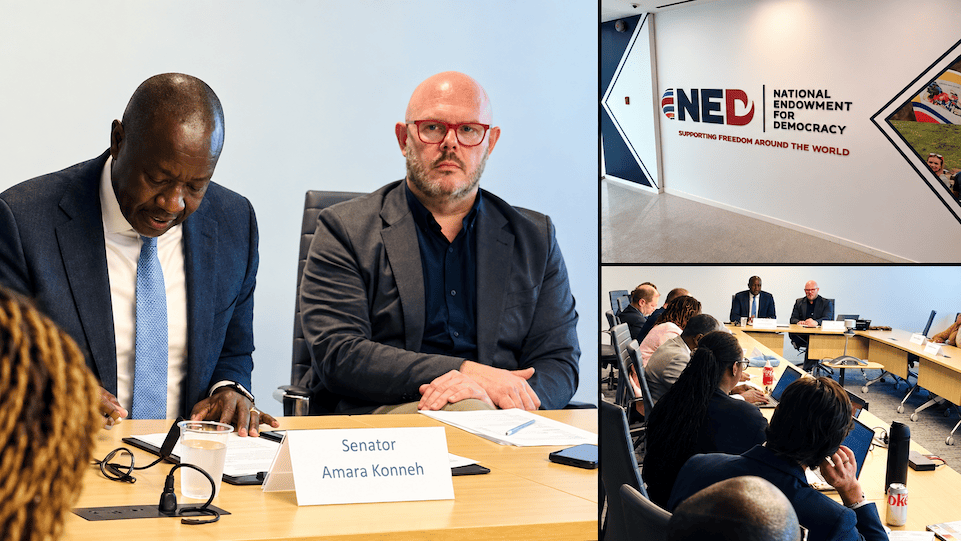
Monrovia – Gbarpolu County Sen. Amara M. Konneh has asked the United States to impose Global Magnitsky sanctions on people who enable mining licensing deals in Liberia and move the proceeds into US real estate, telling a Washington policy audience that the country faces its gravest threat since the civil war and the Ebola epidemic.
By Lennart Dodoo
Sen. Konneh made the request Oct. 7 at a private roundtable convened by the National Endowment for Democracy in Washington, according to a statement his office released Oct. 12. He also asked Washington to support court monitoring in Liberia, resume mentoring of law enforcement officers vetted by the US Drug Enforcement Administration “with appropriate oversight,” and engage the Treasury Department’s Financial Crimes Enforcement Network on active financial intelligence cases.
“Liberia is not yet a captured state. But we are at the most dangerous point since the civil war and the Ebola epidemic,” Konneh said. “My request is straightforward: help us establish transparent regulations before agreements are finalized, and support impartial enforcement of the law after confiscation, whether the suspect is an airport baggage handler, a police crimes director, a former Vice President, or a multinational corporation.”
Sen. Konneh, an independent who chairs the Senate Public Accounts and Audit Committee and previously served as minister of finance and development planning, described two threats he said are unfolding at the same time: corporate capture of the mining sector and the infiltration of state institutions by drug traffickers.
“Liberia is not yet a captured state. But we are at the most dangerous point since the civil war and the Ebola epidemic.”
Sen. Amara M. Konneh, chair of the Senate Public Accounts and Audit Committee
On mining, he said broad executive discretion in negotiating 25-year Mineral Development Agreements has created conditions for companies to capture the country’s regulatory and fiscal institutions. Mining accounts for 12% of gross domestic product and 65% of export earnings, he said, yet affected communities receive less than 3% of direct revenue. The statement does not give a source for those figures.
On narcotics, Konneh said transnational trafficking networks have shown they can penetrate Liberia’s law enforcement, judicial and financial systems. He pointed to two seizures this year: 237 kilograms intercepted at Roberts International Airport in June, valued at $19.2 million, and 3.9 metric tons seized in Duazon in July, valued at $317 million. He said the seizures had links to trafficking networks in Spain, Colombia, Serbia, Croatia and Ukraine.
He also described the spread of kush, a cheap synthetic drug now present in Liberia, Sierra Leone, Gambia, Guinea and Senegal, as both a public health and a governance emergency. Citing the UN Office on Drugs and Crime’s World Drug Report 2025, he said opioid use in West and Central Africa stands at 2.35%, above the global average, and that Africa accounted for 57% of pharmaceutical opioids seized worldwide between 2019 and 2023.
Sen. Konneh said he is advancing a set of reforms in the Senate. They would require publishing all Mineral Development Agreements before ratification, create independent oversight of transfer pricing in iron ore concessions, mandate preserving evidence in drug cases, make financial investigations compulsory in all first-degree drug felonies, and introduce unexplained wealth legislation that allows assets to be forfeited without a criminal conviction.




Discussion about this post