


Published: October 12, 2026
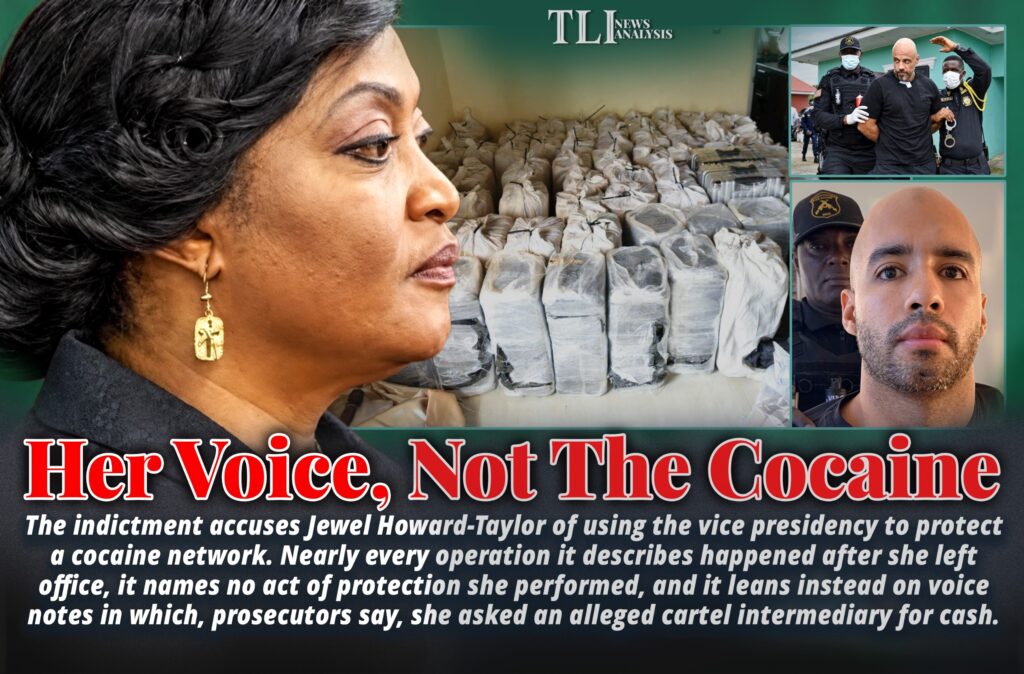
MONROVIA – The State’s case against former Vice President Jewel Howard-Taylor rests on her voice, not the cocaine. A Montserrado County grand jury indictment charges her on seven counts over a US$317 million haul, but it never places her near the drugs. Instead, it builds its most specific evidence on WhatsApp voice notes in which, prosecutors say, she asked an alleged cartel intermediary for money.
By Lennart Dodoo | News Analysis
The charges include a first-degree trafficking count that the indictment describes as non-bailable, and they threaten the medical home detention a judge granted her last month. Yet the 55-page document never describes a single act of protection she is supposed to have provided. The voice notes it relies on are dated Aug. 31, 2026, more than two and a half years after she left office.
That gap between the accusation’s gravity and the evidence behind it runs through every page of the State’s case against her.
A sprawling case with one marquee name
A special grand jury returned the 55-page indictment, and Montserrado County Attorney Cllr. Richard J. Scott Jr. It names 18 defendants. They range from foreign nationals the State describes as the network’s directors to police commanders, National Security Agency personnel, a civil aviation official and businessmen accused of supplying cover companies.
At the center of the case is the July 21 seizure of 3,971 plates of cocaine from a compound on Cement Road in the VOA Community. Prosecutors value the haul at about US$317 million. Two foreign nationals, Srdan Seles and Johann David Garces Grajales, were arrested at the scene.
Howard-Taylor is the most prominent person charged. She is named in seven of the 11 counts: criminal conspiracy, unlicensed importation, unlicensed transportation and dispatch in transit, illicit trafficking, unlicensed exportation, criminal facilitation, and money laundering.
The counts that leave her out are just as revealing. Prosecutors do not charge her with possessing cocaine or with maintaining the Royesville property they describe as the network’s landing and storage site. In the solicitation count, she appears as someone the network sought out, not as a defendant. Across every count that names her, the State’s theory is the same: she supplied what the indictment repeatedly calls “high-level political assurance and cover.”
How prosecutors tell her story
The State’s account begins at her Sophie Road residence in Congo Town.
According to the indictment, Sheik Bashiru Kante, whom prosecutors cast as the network’s Liberian connector, brought two foreign operatives to meet her there. They were Mihovil Vrovac, a Croatian national known as Michael, and Taras Zadereiko, a Ukrainian national known as Tony. The indictment says the men told her they wanted security protection for their business and invited her to meet their boss in Dubai. It says she agreed to protect them.
The trip followed weeks later. Prosecutors allege the operatives gave Kante US$27,000 to cover her travel. They say she led a five-member delegation that left Liberia on Nov. 28, 2021, and returned Dec. 6. In Dubai, at the H Hotel on Sheik Zayed Road, the indictment says the man it calls the network’s principal, Nikola Ivancic, recruited her to provide protection at a high governmental level. According to the State, Ivancic assured her that the cocaine would pass through Liberia without being sold there, and that none of it would be shipped to the United States or its allies.
From there, the indictment follows the money. It attributes four payments to her: a US$27,000 travel fund; a “shopping-gift bag” holding US$45,000; a US$75,000 donation to her Starfish Foundation; and US$15,000 sent through Kante in August 2026. Together, those figures total US$162,000. The US$45,000 gift bag, however, appears only in the money laundering count. It has no supporting account anywhere in the detailed narrative prosecutors lay out elsewhere.
The recordings at the heart of the case
If the Dubai meeting underpins the State’s theory, the voice notes are its centerpiece.
Prosecutors quote three audio files they say she sent to Kante. In one, she allegedly asks him to intercede: “So please ask Nicholas if he could send me some help.” In another, she appears to acknowledge receiving US$15,000: “Thank you. Thank you. I’ve been turning around. I don’t know where I would even get money for the other little boy’s school fees.” Elsewhere, she puts a figure on her needs: “About 60,000.00 US will help me get everybody in school.”
According to the indictment, the conversation then moved onto more dangerous ground. Kante allegedly relayed Ivancic’s complaints about losses in Liberia, including a reference to “the 19 kilos,” and said Ivancic was expecting goods from Sierra Leone. The indictment quotes her response as: “So maybe [they are] being hidden somewhere until a better time.” The bracketed words are the prosecution’s insertion, not hers. The State’s reading is that “they” refers to the State.
The recordings also carry a political dimension. The indictment says she discussed money for party conventions and for campaign organization across Liberia’s 15 counties. It quotes her as saying, “We just need to do this thing the quiet way…that will make it easier to do,” and “My percentage is set in stone. I’m not playing that game again.” According to the State, she said she would discuss the arrangements with her “political superior” once he returned from Ghana and Nigeria. The indictment does not name him.
For all their apparent force, prosecutors handle the recordings cautiously. The indictment describes the statements as “relevant” to her knowledge of and relationship with the network, to be weighed alongside other evidence. It stops short of claiming they prove she knew the money came from cocaine. In none of the passages quoted does she mention drugs.
The indictment accuses Jewel Howard-Taylor of using the vice presidency to protect a cocaine network. Nearly every operation it describes happened after she left office, it names no act of protection she performed, and it leans instead on voice notes in which, prosecutors say, she asked an alleged cartel intermediary for cash.
Where the legal danger lies
The drug counts are the hardest for the State to carry against her. Importation, transportation, trafficking and export are acts the indictment describes in close operational detail: canoes on the Po River, a land purchase at Harris Ward, a police-escorted convoy before dawn on May 30. The indictment attributes each of those acts to other people. Her link to them is the claim that the network relied on her protection. The indictment never says what that protection involved, whom she contacted or what she prevented. The criminal facilitation count raises the same difficulty because the Penal Law provision prosecutors cite requires conduct that actually aided the crime.
Conspiracy works differently, which helps explain why prosecutors lead with it. Under the provision quoted in the indictment, the State must prove an agreement to promote the crime, plus an act in furtherance by any member of the conspiracy. If a court accepts that she struck a deal in Dubai, the convoy and the seizure could count against her even though she took no part in either.
Her greatest exposure may lie in the money laundering count. The 2021 anti-money laundering law reaches anyone who acquires, possesses or uses property while knowing, or having reason to believe or suspect, that it is the proceeds of crime. Suspicion is a far lower bar than knowledge. If the recordings are authenticated, they show her acknowledging US$15,000 and seeking US$60,000 more through a man the State describes as a cartel intermediary. To defeat that count, the defense would have to break one of two links: the proof that the money came from cocaine, or the claim that she had reason to suspect it did.
A timeline at odds with itself
The indictment states that Howard-Taylor served as vice president from January 2018 to January 2023. Her term actually ended in January 2024.
The document is no more consistent about when she was recruited. Two passages place the introduction at her residence in October 2021. A third says it happened in 2022. Count II, meanwhile, dates the Dubai meeting at which Ivancic disclosed his plans to “in or about November 2022,” a full year after the November 2021 trip prosecutors otherwise document to the day.
Almost every concrete operation the indictment describes happened after she left office: the aircraft that arrived in August 2025, the airline licensing that followed, the Marshall beach reconnaissance, the 2026 land purchase, the May convoy and the July seizure. The indictment does not explain what protection a former vice president could offer during that period, or how she would have delivered it.
Count VI links her to a three-container cocoa shipment released from the Freeport of Monrovia on Oct. 12, 2021. According to the indictment, that shipment left before she ever met Ivancic in Dubai. The same paragraph appears almost word for word against eight other defendants, and it does not state that cocaine was ever found in those containers.
What comes next
Criminal Court ‘C’ issued the writ of arrest on Oct. 7. On Sept. 4, that court’s judge, Ousman F. Feika, moved her from the Monrovia Central Prison to home detention on medical grounds. The writ bears a handwritten notation that appears to include her name and the time 13:14 on Oct. 7, consistent with her acknowledging service.
The first legal battle is likely to center on her detention. The trafficking provision cited in the indictment classifies Schedule I offenses as first-degree felonies and bars bail. A second fight may follow over whether prosecutors can prosecute conduct dating to 2021 under a drug law enacted in 2023. Prosecutors are expected to argue that a conspiracy extending into 2026 brings the earlier acts within the statute’s reach.
The State has listed three Liberia National Police officers as witnesses and has presented documentary evidence. The indictment does not specify how the voice notes were obtained, from which device, or who will authenticate them in court. In a case built so heavily on her own words, that may prove to be the question on which it turns.




Discussion about this post