


Published: October 6, 2026
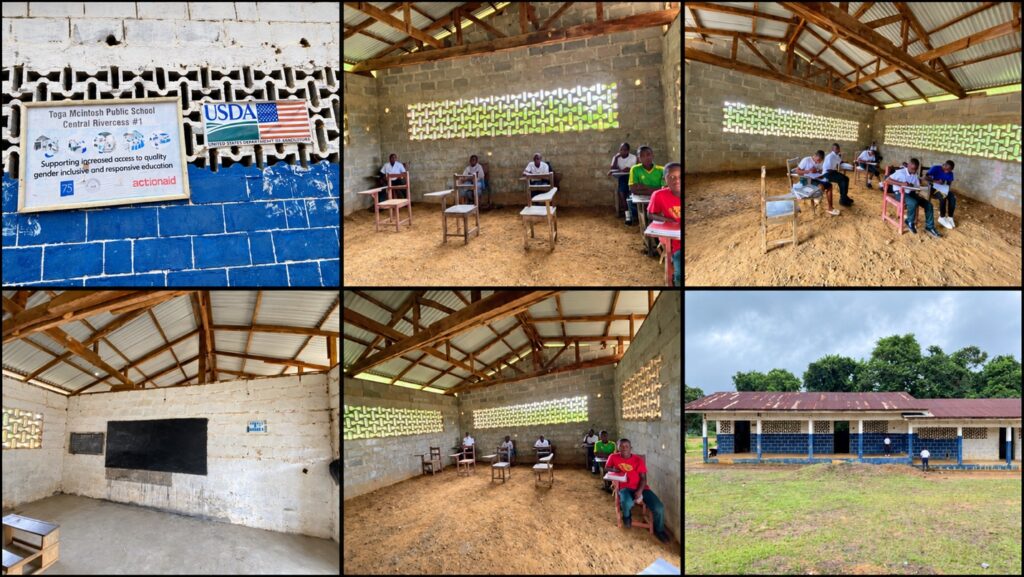
YARPLEH TOWN, River Cess County – Two administrators at a government-run school in Yarpleh Town say they are walking away from the classroom after months without pay, and Togar McIntosh, the former foreign minister who reestablished the school and turned it over to the government, says he may place it under a private trust if the Ministry of Education does not commit to fixing it.
Principal Samuel W. Yarpleh said he and four other staff members at Toga McIntosh Elementary and Junior High School have each gone four months without their government salaries.
“I, as the principal, have not received my salary for March, April, July, and August. We are five teachers in this situation,” he said.
Eugene F. Gowah, the dean of students, said he has not received his government salary since February and has stopped teaching.
“When you wake up in the morning, you can be confused. When your mind is settled, that is when you can teach. So, for now, since I don’t have anything, I have decided not to continue. Let me rest my mind before I start giving the children nonsense as lessons,” Gowah said.
Samuel Togo Guyjay, the vice principal for administration, said he spent more than a month in Monrovia trying without success to resolve his pay. Guyjay, who said he holds a bachelor’s degree, an associate degree and a C Certificate, said he is ready to quit.
“I am well trained, but now I am frustrated. I don’t want to be in the classroom again,” he said. “If you are receiving your correct salary according to your qualifications, you will be more encouraged to continue.”
McIntosh, who served as minister of foreign affairs in the Ellen Johnson Sirleaf administration, said the teachers’ situation troubles him.
“I am not happy because these are people who are making big sacrifices,” McIntosh told The Liberian Investigator in an exclusive interview Wednesday, speaking of teachers who keep working despite long salary delays.
He said he will formally ask the government for clear commitments and a timeline for fixing the school’s buildings and staffing. If it does not follow through, he said, he may place the school under a trust supported by philanthropists, and he wants to start a small farm to help sustain it.
Gowah also alleged that teachers were asked to pay L$3,000 each, in Liberian dollars, as part of efforts to resolve their salary problems after they contacted the county education officer.
“We don’t have 3,000 Liberian dollars each to pay, so we are fighting our own battles. That is why we hardly call our CEO anymore,” he said.
The Liberian Investigator could not independently establish whether such a payment was required, requested or collected.
Dailay David Konway, the River Cess County education officer, said public schools across the county face shortages of teachers and infrastructure.
“We have challenges. We are not saying that there are no challenges,” Konway said.
He said some schools depend on volunteers and that county officials only recommend staffing to the Ministry of Education, which controls recruitment and deployment. He also cited difficulty reaching some communities.
“We are doing our best,” Konway said.
The pay crisis is thinning a staff that was already stretched. Yarpleh said the school has 270 elementary and 30 junior high students, taught by six government-paid teachers and five volunteers. During The Liberian Investigator’s visit, only five staff members were attending to classes: the principal, the vice principal for administration, the dean of students, a volunteer teacher and one other official.
Enrollment has also outgrown the classrooms, Yarpleh said. One early childhood class has 65 students.
“The number of students we have this year is higher than our sitting capacity, so we really don’t know how we will handle this,” he said.
Volunteer teacher Sarah G. Thomas, who recently completed B Certificate training in Kakata, Margibi County, said seating is the main problem.
“It is very low, the chairs need reconditioning. No good chairs and desks,” Thomas said.
Several classrooms had unplastered floors and no doors or ceilings, and the junior high building remains largely unpainted and unplastered.
Yarpleh said administrators have documented the school’s problems on ministry templates more than three times without result, and that the education minister saw the conditions herself during a county tour.
“Even when the new Minister visited the school during her first county tour, she saw the condition of the school and felt bad. But since then, there has been no improvement,” he said.
The school existed before the civil war but stopped functioning after it, until community elders appealed to McIntosh, Yarpleh said.
“The school was established way back, but after the war, there was no school. Toga McIntosh moved into the community, the elders appealed to him. That was how he reestablished the school on September 3, 2006,” Yarpleh said.
“When McIntosh built the school, he turned it over to the government, but the Ministry of Education is really not paying attention to this school,” he said.
McIntosh said he has raised the school’s condition with ministry officials before, with little result, and that the campus has received little or no government construction support in six or seven years.
“The physical part of this is very, very discouraging,” he said.
He said he has paid for much of the flooring himself and supplied 17 dump trucks of dirt, about 300 bags of cement and several truckloads of sand to repair parts of the school.
“If the government cannot complete it all by themselves, I can also contribute to it,” McIntosh said. “But they have to get involved in making sure we have the classrooms, doors, blackboards, benches or chairs.”
McIntosh said he sponsored a former student through high school and teacher training, and the student returned to the school as a teacher. That teacher has not been paid for more than a year because of an error in his payroll and banking information, McIntosh said, despite his own follow-up with the ministry and finance officials in Monrovia.
He expects to continue the flooring work before the end of October, depending on resources, but said that alone will not save the school.
“Beyond the floor, we have to have the doors, we have to have the blackboards, we have to have the benches, we have to have the place electrified, all the equipment and the wiring,” McIntosh said.
The school started with four children in a church building, he said, and has since produced students who passed national examinations.
“I’m not going to live forever,” McIntosh said. “This is not a school that I put there to make money. For the time we started till now, it’s free education. And I hope it should remain that way.”





Discussion about this post