


Published: October 2, 2026
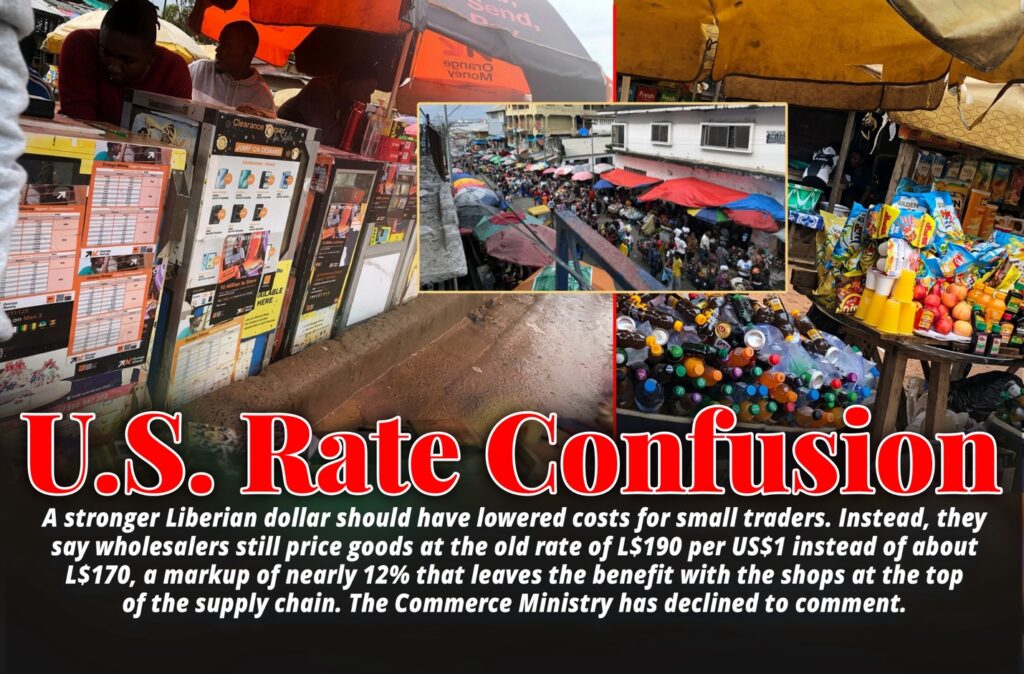
MONROVIA – Small traders in Monrovia say wholesale shops are still charging them L$190 for every US$1 of goods, even though the exchange rate has moved to about L$170. They are paying more for stock while their customers expect prices to fall.
For a trader buying US$5 worth of goods, that means paying L$950 instead of L$850. Traders say the difference is their profit.
By Alphanso G. Kalama
“When we carry L$850 to buy, which is five dollars’ value as per the 170 rate now, it won’t be accepted. You will have to add an additional L$100 before you can get that item,” said Blaack Sheriff, who sells used clothes in the Waterside area. “At the end of the day, we go home with nothing.”
Sheriff said a system that favors wholesalers over small retailers leaves traders no choice but to absorb the loss.
Wolo Flomo, who sells shoes on Broad Street, called the drop in the rate “artificial.” He said Lebanese, Indian and Fula store owners often turn down U.S. dollars from small traders and ask for Liberian dollars at L$190, not L$170.
He said some U.S. dollar prices have also risen.
“Things we were buying in US for $60 are now being sold almost for $65. This is affecting us as sidewalk sellers. We face hard time with our customers who complain about increase in price and don’t even want to reason with what we are going through now,” Flomo said.
Flomo blamed ineffective market inspectors. If inspectors were active, he said, no store would set its own rate in defiance of the Central Bank of Liberia.
Gabriel Gao said his sales have slowed since the rate began to shift, and customers now bargain over every price.
“I decided to add the equivalent of the additional money we have been compelled to spend on goods. All I can see now is slow buying because customers are complaining, and these things are not fair,” Gao said.
He called on the Ministry of Commerce and Industry to monitor the situation.
“Central Bank should be controlling the rate, and not Fula people in these stores around here,” Gao said.
Money changers say they cannot compete. Daniel H. Morrison, who changes money on Broad Street, said large businesses deal directly with the Central Bank, while street exchangers cannot meet its licensing requirements.
“We don’t have control to compete with these people when it comes to how they handle the rate because they deal directly with the CBL, and for us, we can’t because of the plenty requirements set by the bank like business registrations and other higher standards which we can’t get,” Morrison said.
He said the government should relax some of those requirements so local exchangers can take a larger share of the money-changing business and help stabilize the rate.
Another money changer, Thomas S. Weah, said Liberian dollars have grown scarce on the market, though he said he could not say whether people are holding on to them.
“Liberian Dollar hiding small small on the market. I don’t know if people holding it. The whole system is confusing my brother,” Weah said.
Weah pointed to phone scratch cards as an example of prices that have not followed the rate.
“US$1 is now $L170. But go and ask for one scratch Lonestar or Orange Card, it’s still on sale for so for L$190 or L$200,” he said.
Kemah Sheriff, who sells school materials in Waterside Market, said parents who used to buy in bulk now buy single items.
“I sell children school materials. As you can see, my business is stocked because of this rate,” she said.
Esther Johnson, who sells gasoline in Congo Town, said the extra Liberian dollars she must pay to buy stock are eating into her small capital.
“I sell gas to support my children. When you take Liberty to buy, they say u must add something you not expecting. That extra money is my profit. If I increase the price, customers go to the next person. So I am losing every day,” Johnson said.
Bendu Kamara, who sells fruit at Boulevard junction, said transportation and market fees remain high even as customers insist fruit should be cheaper. Selling in Liberian dollars and buying in U.S. dollars, she said, leaves her sometimes unable to cover her transport fare.
Mary Chea, who sells dried fish and palm oil on Randall Street, said she no longer knows how to price her goods.
“We don’t know which rate to use again. Today 170, tomorrow 190. We are confused. Government must come on the ground and check these people,” Chea said.
The Ministry of Commerce and Industry has not publicly addressed the traders’ complaints. Jacob Parley, the ministry’s director of public affairs, said he could not comment without consulting others at the ministry. He said he was busy and would get back to The Liberian Investigator, but he had not done so by press time.
Traders are calling on the Commerce Ministry and the Central Bank to enforce a uniform rate and step up market inspections.





Discussion about this post