


Published: September 30, 2026
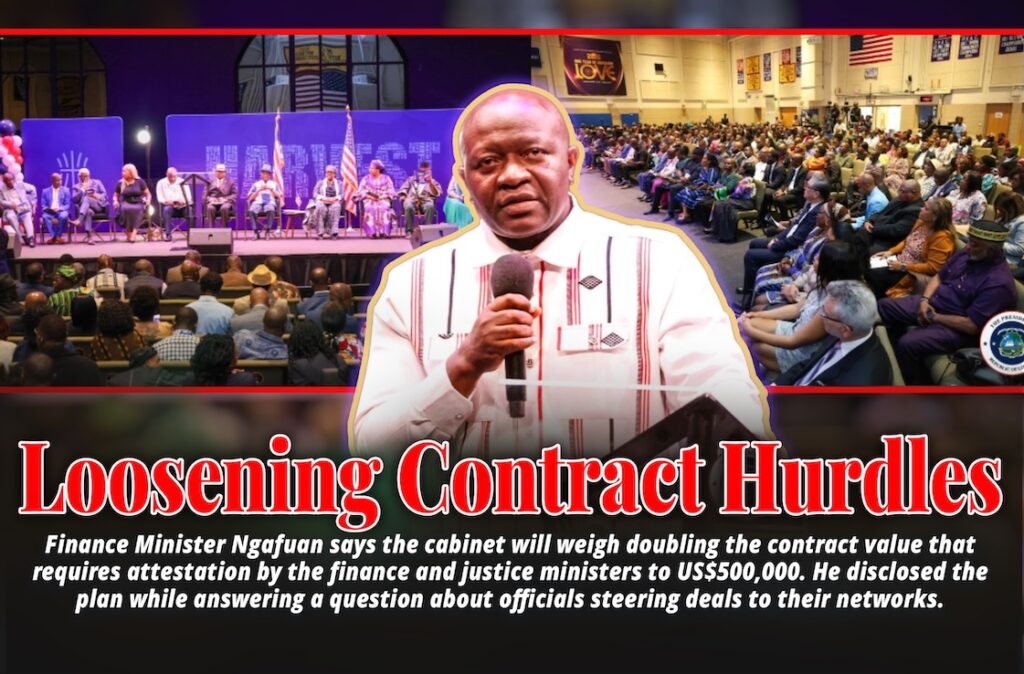
OLNEY, Md. – Government contracts valued between US$250,000 and US$500,000 would no longer require attestation from the ministers of finance and justice under a proposal the government plans to present to the cabinet within weeks, Finance Minister Augustine Kpehe Ngafuan said.
By Lennart Dodoo
The change would double the value at which a contract triggers ministerial review. Ngafuan disclosed the plan at a town hall with Liberians in the United States during the Liberia Diaspora Conference in response to a question about officials steering contracts to their own networks.
“One of the things we intend to table for the cabinet in the next few weeks is the requirement that contracts of $250,000 and above be attested by the two ministers,” Ngafuan said. “So we’re going to be proposing to increase it to $500,000.”
Minister Ngafuan said the current threshold was set when the national budget was much smaller. “The last time that regulation was crafted, the budget was around $300 million or $400 million,” he said. He described the proposal as part of a review of the procurement regulation aimed at clearing bottlenecks.
The government’s revenue base has grown since then. In his prepared remarks at the same town hall, President Joseph Nyuma Boakai said domestic revenue rose from about US$612 million in 2023 to US$699 million in 2024 and US$848 million in 2025.
The minister was answering a three-part question from Isaac Vaatukpa, a member of the audience. Vaatukpa said most procurement notices carry a five-year experience clause. “In some instances, we see a deflection or diversion of some of those contracts,” he said.
He asked whether the government would relax the five-year requirement for recognizing equivalent international experience, establish a diaspora platform that publishes procurement guides and business registration processes, and “enforce strict conflict-of-interest rules that prevent officials from steering contracts to their own networks.”
Ngafuan did not announce any new conflict-of-interest rule. He directed complainants to existing bodies: the Public Procurement and Concessions Commission’s board of commissioners and its complaints board, the Liberia Anti-Corruption Commission, the whistleblower mechanisms, and the Office of the Ombudsman.
“So where you find that in a procurement process someone is queuing it in order to get it and and there’s a conflict of interest, report it. Report it. And it will be investigated,” he said.
The Finance Minister said that where investigators find evidence of corruption, the anti-corruption commission and other institutions are there to act. He said he would find time to give Vaatukpa more information.
Ngafuan said the government also plans to speed up the process by setting deadlines inside ministries. The law gives the PPCC 14 days to decide on matters that reach it, he said, but sets no deadline for the ministries’ evaluation and procurement committees. “We’re going to timeline those processes so that people in the process can benefit,” he said.
He said the government would also push the PPCC to make decisions faster. “So the transparency of the process will benefit everyone,” he said.
On the five-year experience requirement, Ngafuan said the government is reviewing it but will not remove it. He said experience requirements exist everywhere, because an entity awarding a construction contract wants to know what the bidder has done before.
“It will be difficult for us to scrap it, to say zero requirement. We’ll try to find a comfortable middle,” he said. Until then, he advised Liberian businesses to partner with established firms and use those partnerships to build a record of experience. He said the government’s cadet and internship programs for young people are meant to address the same barrier.
The proposal comes as the government moves procurement onto an electronic platform. Liberia launched its electronic government procurement system in January 2025. The first phase covered six procurement entities, and 56 entities had been onboarded for phase two training by May 2026. The system is designed to strengthen competition, improve transparency and provide better value for money.
Ngafuan acknowledged that the move to e-procurement has created problems. “E-procurement, yes, on the surface is good, but this transitional process has caused some challenges,” he said, adding that some businesses were struggling to compete on the platform and were receiving training.
He urged diaspora businesses to follow a presentation the PPCC’s executive director had given earlier in the conference, which he said the diaspora office had shared. “I think this is a case for more information dissemination so that you can take up some of the opportunities that exist,” he said.
Earlier in the session, Minister of State without Portfolio Mamaka Bility told the audience that Liberians abroad do not need to return home to compete for government work. “You can stay online and bid for projects in Liberia,” she said.
President Boakai also used his remarks to point to the administration’s accountability record. He said the government had strengthened asset declaration compliance and taken administrative action against officials who failed to meet integrity requirements. He said the General Auditing Commission had audited major public institutions, including the Office of the President, the Legislature, the Judiciary, and the Central Bank.






Discussion about this post