


Published: September 28, 2026
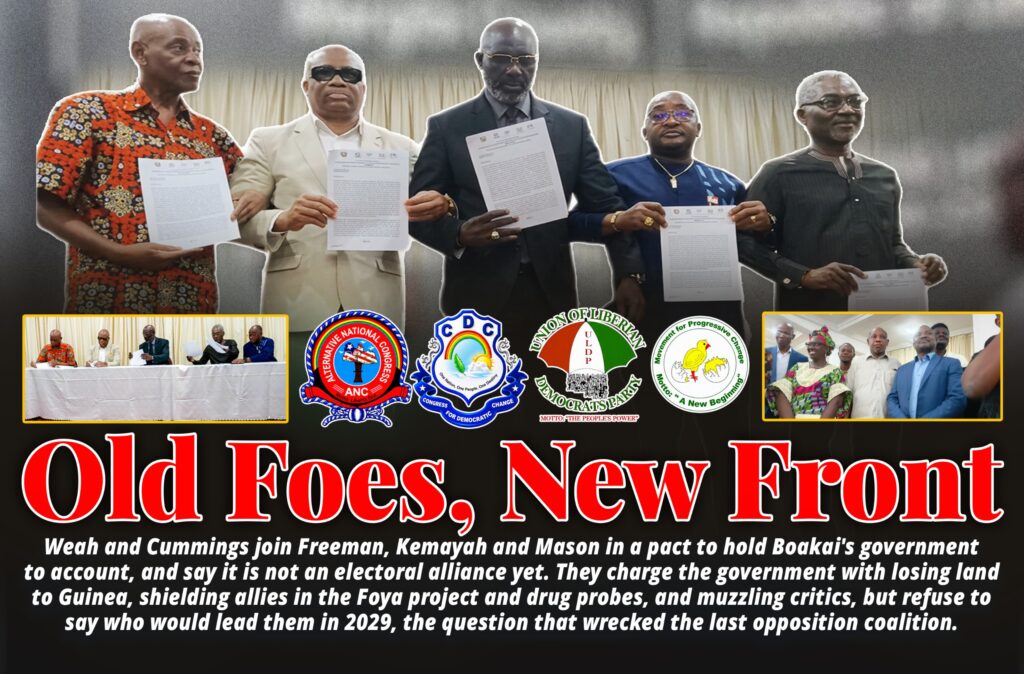
MONROVIA – Former President George Weah and Alexander Cummings, a founder of the opposition coalition built to unseat him, joined three other opposition leaders Sunday in a pact to confront President Joseph Nyuma Boakai’s government. They deliberately left open the question that destroyed that coalition: who leads the ticket.
By Lennart Dodoo
The five leaders signed a joint communique at the Sinkor Palace on Tubman Boulevard, where Simeon C. M. Freeman of the Movement for Progressive Change hosted their second roundtable. Weah signed for the Coalition for Democratic Change, Cummings for the Alternative National Congress, Dee-Maxwell Saah Kemayah Sr. for the Movement for Economic Empowerment and Jonathan A. Mason for the Union of Liberian Democrats Party.
In the communique, the parties pledge to “jointly and constructively hold the Boakai-Koung-Unity Party-led Government accountable for its stewardship of the Republic.” They accuse the government of losing territory to Guinea, running a selective fight against corruption and drugs, defying the Supreme Court, and using a new cybercrime law against critics.
At a news conference after the signing, the leaders refused to be drawn on 2029. “We are not discussing who becomes president, who becomes vice president,” Freeman said.
“We’ve also agreed that this is not an electoral alliance,” Cummings said. He added that the arrangement “may become one.”
The communique carries the same ambiguity. “Our cooperation is grounded in addressing issues of national concern, not mere electoral calculations,” it says. It, however, predicts that “the political implications of that success will naturally inform the 2029 electoral agenda.”
On Feb. 21, 2019, Cummings, Boakai, the late Charles Walker Brumskine and Benoni Urey signed the agreement that created the Collaborating Political Parties. The alliance was meant to field a single ticket against Weah. In the December 2020 special senatorial election, it won six of the 15 races.
It came apart in early 2022. Boakai and Cummings could not agree on who would head the 2023 ticket, and the partners fought over an alleged alteration of the coalition’s framework agreement. The All Liberian Party filed its withdrawal on Jan. 28, 2022, and Boakai’s Unity Party followed on Feb. 17. The Supreme Court declined to rule on the alteration claim, and the state dropped its criminal case against Cummings.
Boakai then took Nimba Sen. Jeremiah Kpan Koung of the Movement for Democracy and Reconstruction as his running mate and defeated Weah in 2023. Cummings, running under what remained of the collaboration, won 29,613 votes, or 1.61%. Boakai won Weah with a margin of about 20,567 votes.
Sunday’s document says the new arrangement was shaped by those failures. “We will build trust through actual consultations, collaboration and measurable national engagement rather than attempting to manufacture opposition political unity by declaration,” it says. Each party keeps its own identity and organization, with no merger or shared leadership structure.
Freeman compared a rushed alliance to a hasty marriage that ends in divorce. “So we’re trying to know each other. We’re trying to like each other,” he said.
Weah said the talks had never turned to candidacies. He said that when the leaders first met, there was no discussion “on who going on a ticket or who joining who.”
“We were one voice and we signed a document to work together in the interest of our country,” Weah said.
Weah convened the first roundtables Sept. 5-6 at the Jamaica Resort in Paynesville. Freeman said one leader had stepped away before the structure was even formed, and said the group looked forward to working with him.
Cummings acknowledged that the leaders had agreed in September to issue a joint statement the following Friday. “Last time we met, we did agree that we were going to issue a joint communication,” he said, adding that the leaders later decided that plan “was not cast in stone.” He said Sunday’s document was produced by a joint technical committee of the parties.
The communique’s sharpest charges concern corruption and drugs. It calls a US$10 million construction project in Foya, Boakai’s hometown, “a flagship of corruption.” It says the project violated procurement and budget rules and that its funding sources have never been credibly explained. The Alternative National Congress asked the Liberia Anti-Corruption Commission to investigate the project in May, the communique says. The commission replied in June that it would conduct a “preliminary assessment,” and no action has been made public since.
The parties also demand an investigation into the Central Bank of Liberia’s May 2024 transfer of US$8 million in reserves to SIB Liberia under an April 18, 2024, presidential directive.
On drugs, the parties call for an independent commission to investigate the US$19 million and US$317 million busts. They cite Police Inspector General Gregory Coleman, who said senior officials at the highest level of government were involved, and complain that calls to remove Coleman from the investigation have been ignored.
They propose that the commission include the Liberia National Bar Association, the Press Union of Liberia, civil society groups, the Liberia National Muslim Council and the Liberia Council of Churches. They also charge that the government prosecutes opponents quickly while dismissed security officials linked to the cartel remain free.
On territory, the parties say Guinea “occupies a Liberian territory in Foya District, Lofa County.” They accuse the government of failing to press the Economic Community of West African States, the African Union and the United Nations to act.
They also condemn:
- the recent arrest of a young man accused of spreading an AI-generated image of the vice president, calling it evidence that Liberians “may be living under a police state”
- the government’s request in March that the European Union recall its ambassador, Nona Deprez, after she called for transparency in the mining sector
- what they describe as armed security officers menacing Weah and supporters when he returned through Roberts International Airport on Sept. 2
The parties say they are alarmed by what they describe as the new leadership of the National Elections Commission’s perceived intention to deregister political parties. “No such actions would be tolerated, and any such attempt will be resisted in the strongest term,” the communique says.
The parties offered one concession to the government. They commended it for passing US$1 billion in domestic revenue, but said the real test is the budget’s impact on ordinary Liberians.
Kemayah said the technical committee, made up of two representatives from each party, has presented a first draft of terms of reference and a phased roadmap for cooperation. He said the leaders will next meet on or around Nov. 1.



Discussion about this post