


Published: September 16, 2026
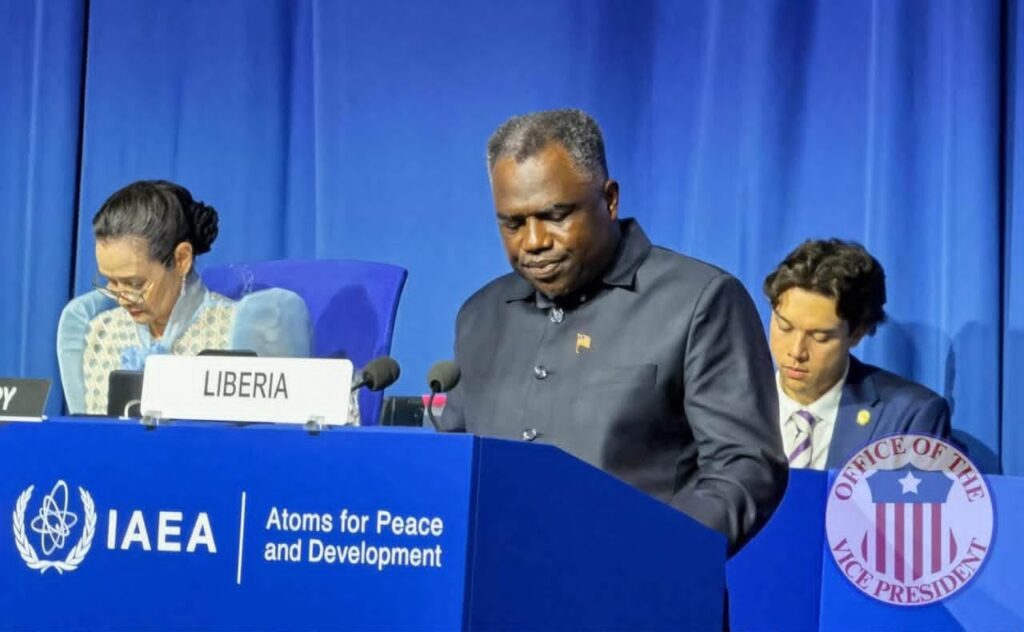
VIENNA, Austria — Vice President Jeremiah Koung, Sr. has urged the international community to make peaceful nuclear science and technology more accessible to developing countries.
By: Masefane Konneh
He put Liberia’s argument forward, noting that the benefits of nuclear applications must reach nations facing pressing challenges in cancer treatment, food security, agriculture, environmental protection and radiation safety regardless of their economic status or geographic location.
Addressing the 70th General Conference of the International Atomic Energy Agency (IAEA) in Vienna, on September 14, Vice President Jeremiah Kpan Koung Sr. said developing countries should not be left behind in accessing technologies that could significantly improve healthcare, strengthen food production and address other national development challenges.
Koung delivered Liberia’s National Statement on behalf of President Joseph Nyuma Boakai, “We believe that access to peaceful nuclear technology must not be determined by geography or by national income. Its benefits must reach people in countries with the greatest needs,” Koung said.
The Vice President placed particular emphasis on Liberia’s cancer burden, citing approximately 4,217 new cancer cases and 2,745 cancer-related deaths recorded in 2024.
According to Koung, the Government of Liberia is working to establish the country’s first comprehensive cancer diagnosis and treatment center and is mobilizing at least US$22 million for the construction, equipment and sustainable operation of the facility.
He appealed to the IAEA and international partners to continue supporting Liberia through the Agency’s Rays of Hope initiative, which seeks to expand access to cancer diagnosis and treatment in countries with limited capacity.
“The IAEA’s Rays of Hope must reach countries where cancer patients have the least access to diagnosis and treatment,” Koung said.
Beyond cancer care, Koung said Liberia is seeking to expand the use of nuclear science to address challenges in agriculture and food security.
He highlighted IAEA-supported initiatives, including the Atoms4Food mission, which is assisting Liberia with efforts aimed at crop improvement, livestock development, nutrition and strengthening agricultural value chains.
The Vice President said applying nuclear science in these areas could help Liberia improve food production and build greater resilience to environmental and agricultural challenges.
Koung also said Liberia has drafted a new nuclear law to strengthen the country’s regulatory framework for radiation protection, oversight, and the security of radioactive materials.
He said the legislation forms part of Liberia’s efforts to ensure that the peaceful use of nuclear technology is accompanied by appropriate safeguards to protect the public and the environment.
The Liberian Vice President further called for predictable financing for the IAEA Technical Cooperation Fund, arguing that developing countries need sustained support to access specialized training, modern equipment and scientific knowledge.
He said Liberia stands ready to deepen its cooperation with the IAEA and development partners to translate nuclear science into practical benefits for Liberians.
“We stand ready to work with the IAEA and all partners to translate scientific cooperation into cancer treatment, resilient agriculture, safer communities, the peaceful use of nuclear science, and renewed hope for our people,” Koung said.
Liberia’s participation in the 70th IAEA General Conference comes as the Government seeks to strengthen international partnerships around key national priorities, including healthcare, food security, environmental protection, radiation safety and scientific capacity.
The conference also provides Liberia an opportunity to advocate for greater technical and financial support for developing countries seeking to apply nuclear science and technology to development challenges.




Discussion about this post