


Published: July 27, 2026
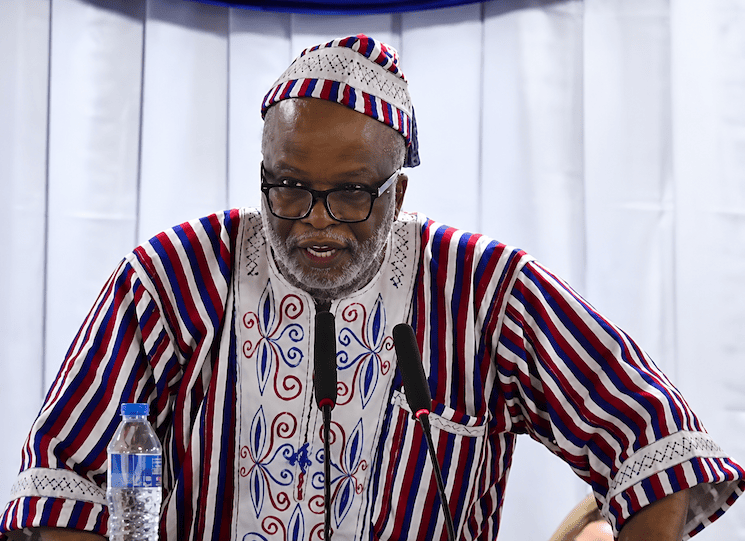
BUCHANAN, Grand Bassa County – National Orator Herbert Brewer told Liberians at the country’s 179th Independence Day celebration that their history is a national asset they have been taught to undervalue, and that a people who lose confidence in their past eventually lose confidence in themselves.
Speaking Monday at the national program in Buchanan, the Liberian-born historian built his oration around a question he said young Liberians ask both quietly and aloud. “What is there to celebrate?” Brewer said, recounting the argument that the country’s history is “little more than a catalog of failure and disappointment” and that “the whole idea of Liberia was a mistake.” He set out to answer it.
“Liberian history is one of our greatest national assets,” Brewer said. “Our great challenge is that too many have come to believe that history has little value. Yet a people who lose confidence in their history eventually lose confidence in themselves.”
“Liberian history did not begin in 1847. Nor did it begin in 1822,” he said, arguing that sovereign African societies governed themselves on this coast for centuries before the state existed, maintaining diplomacy, commerce and justice systems of their own. Independence, he said, “did not begin in 1847. What independence did, however, was to give that older aspiration a new and modern constitutional form.”
Brewer pressed the point that the founding was a joint act rather than a settler achievement, naming indigenous figures he said interpreted the coast’s politics and languages for the arriving American Colonization Society and built the trust that made settlement possible. He argued that the rulers of Cape Mesurado, who a century earlier had refused to cede sovereignty to European slave traders, chose to transfer it to the new black republic and so “became the co-founders of Liberia.” That fact, he said, “deserves a more prominent place in our national history.”
He placed July 26 in world history rather than just national history. Citing Joseph Jenkins Roberts, whose biography Brewer described as compelling, he quoted the first president’s stated purpose for independence: “We are in this to vindicate the race from scandal.” Brewer said the 1847 declaration was significant because “a free black people declared to the world that they possess the right and the capacity to govern themselves,” at a time when slavery still existed and European empires were expanding. He also noted that after the 1884-1885 Berlin Conference divided Africa, only Ethiopia and Liberia kept their sovereignty recognized—Ethiopia by defeating Italy in battle, and Liberia “through diplomacy, international law, and political skill.”
He described the Atlantic slave trade as a catastrophe that “shattered families, redirected economies” and touched every society in present-day Liberia, and he called the 1926 Firestone agreement one of the decisions that most profoundly shaped the modern country, promising investment while pulling labor away from small-scale farming and concentrating power in the executive. History, he said, “asks us first to understand and only then to judge.”
He closed with a charge to the young, drawing a distinction between the past, which cannot be changed, and history, which he called “what we choose to remember.” “Do not inherit only the flag,” he said. “Inherit the sacrifices that give the flag meaning. Do not inherit only the Constitution. Inherit the generations of women and men who struggled, often against impossible odds, to preserve the freedom that you enjoy today.” He told them not to be persuaded that their history is something to be ashamed of. “Claim it. All of it.”
President Joseph Nyuma Boakai, delivering the Independence Day message, took up the same theme and turned it into policy. The year’s commemoration ran under the theme “Strengthening National Identity Through Liberian-led Historical Leadership,” and Boakai said the work of writing the national story should sit with Liberians themselves.
“A nation that understands its history is better prepared to shape the future,” Boakai said. He argued that national identity “cannot be found only in the events of recent decades” and had to be sought across the whole of the country’s journey “from Liberia’s conception in 1819 to independence in 1847.”
Boakai used the address to announce several heritage measures. He said he was creating a national historical recovery and repatriation initiative to work with international partners and universities to bring back copies of historical records related to Liberia. He committed to modernizing the National Archives and the National Museum, which he said had long operated under difficult conditions, through better infrastructure, conservation and digitization. He directed the establishment of an intergovernmental technical committee to study the future of the [Kendeja] Cultural Center and recommend its restoration and integration into a national heritage system. And he said his administration would revive a National History Project led by professional historians, archivists, archaeologists, anthropologists and linguists, insisting it “remain independent of partisan influence” and that “history should never be written through the lenses of political convenience.”
“Nation-building is therefore not simply the work of government; it is the responsibility of every citizen,” Boakai said, adding that every Liberian, “regardless of county, ethnicity, religion, political persuasion, gender, or social background,” should see themselves in the national story.
Grand Bassa is one of the three original counties, with Montserrado and Sinoe, whose delegates signed the Liberian Declaration of Independence on July 26, 1847. Four men represented Grand Bassa at the constitutional convention that year: Anthony Gardner, John Day, Ephraim Titler and Amos Herring, according to historical records. The county’s capital is named for Thomas Buchanan, the first governor of the Commonwealth of Liberia. The coast around Edina and Bassa Cove was among the earliest settlement areas outside Monrovia, and it was the site of the 1835 Port Cresson massacre early in the settlers’ contested arrival.
The national celebration last returned to Grand Bassa in 2020, and before Monday the county had also hosted major independence observances in earlier years as part of a decentralization policy that rotates the event outside Monrovia.





Discussion about this post