


Published: July 20, 2026
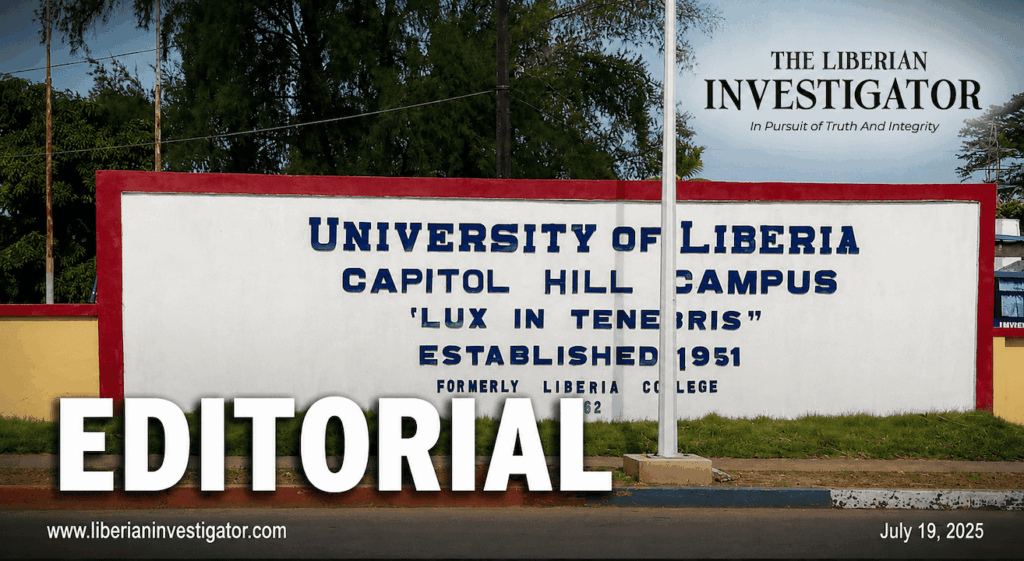
The University of Liberia has gone dark. Not by storm, not by decree, but by the collective decision of the men and women who teach its classes and run its offices, who on Friday shut every campus, suspended every duty and declared they have no confidence in President Layli Maparyan and two of her senior lieutenants. It is the gravest institutional rupture at the state university in recent memory, and it did not come from nowhere.
Let us be honest about the grievances. Unpaid NASSCORP contributions are not a bargaining chip; they are workers’ deferred wages, held in trust, and their non-payment is a breach of both law and decency. Unpaid salaries, absent medical insurance, and unresolved retirements are not the complaints of a pampered class. They are the basic terms of employment that any institution, least of all the nation’s flagship university, should meet before it speaks of excellence. And when faculty allege that millions in tuition revenue cannot be accounted for while US$15,000 is reportedly found to send the president to Harvard, the administration owes the public more than silence. It owes an accounting, line by line.
Dr. Maparyan arrived at Capitol Hill carrying enormous goodwill as a scholar of international standing recruited to renew a broken institution. Goodwill is not a currency that lasts. Eighteen months into her tenure, her own faculty and staff have unanimously judged that the promises made at her installation remain unmet. She may dispute that verdict. She cannot ignore it. The first duty of leadership under a vote of no confidence is not to dismiss the voters but to answer them, publicly, specifically and quickly, and as of press time her administration had said nothing at all.
But the associations, too, should hear a hard word. A leadership that threatens its own members with the “full wrath” of discipline for showing up to teach has borrowed the language of the very authoritarianism it claims to resist. Lecturers who wish to honor their obligations to students are not strikebreakers to be punished; they are professionals exercising the same conscience the associations invoke. The moral force of this action rests on its voluntariness. Coercion cheapens it.
And then there are the students, tens of thousands of them, who appear nowhere in Friday’s resolutions except as collateral. They have paid their fees, the same fees whose management is now in question. Many are the first in their families to reach university. Every week this shutdown holds, their semesters slide, their graduations recede and their faith in public education erodes a little more. Neither the administration nor the associations has told them what happens to their academic year. They deserve better than to learn their fate from the silence between warring press statements.
Ultimately, this crisis lands where it belongs: at the Executive Mansion. The University of Liberia is a state university. Its subsidy is appropriated by the government; its president serves at the pleasure of the visitor, who is the President of the Republic. If salaries are unpaid and pension contributions are in arrears at a public institution, that is not merely a campus dispute, it is a governance failure, and it sits uneasily beside an administration that speaks fluently of an ARREST agenda whose first pillar is agriculture but whose “E” is education. President Boakai cannot watch this from across town. He should direct an immediate, independent audit of the university’s finances, including the tuition accounts and the Harvard expenditure, and he should convene the administration and the associations before the July 31 deadline the staff have already set, not after it expires into something worse.
There is a version of this story in which Friday’s shutdown becomes the shock that finally forces transparency at Capitol Hill, honest books, paid contributions and a university worthy of its students. There is another version in which it becomes one more Liberian institution that broke and stayed broken while its leaders litigated blame. The difference between the two will be decided in the next twelve days.
The lights at the University of Liberia must come back on. But they should come back on over an institution that has opened its books, paid its debts and remembered whom it exists to serve.




Discussion about this post