


Published: June 3, 2026
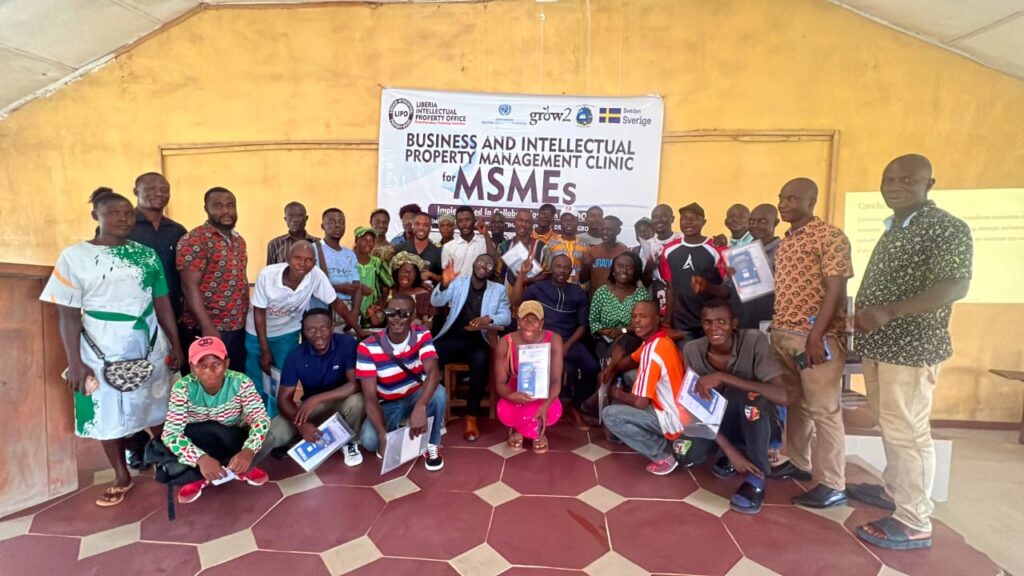
MONROVIA – Liberia’s intellectual property agency and a United Nations industrial development organization have launched a 23-day training program targeting 100 small businesses across four counties, aiming to help entrepreneurs recognize, protect, and commercialize assets they already have but often don’t know how to leverage.
The Business and Intellectual Property Management Clinic, a joint effort of the Liberia Intellectual Property Office and the United Nations Industrial Development Organization through its GROW-2 Project, officially opened on June 1 in Voinjama, Lofa County. The program will serve Lofa, Bong, Nimba, and Margibi counties, focusing on micro, small, and medium-sized enterprises working in agriculture, agro-processing, and related value chains.
Participants will receive practical training in intellectual property identification and registration, branding, business management, financial literacy, market positioning and enterprise growth planning.
Speaking via Zoom at the opening ceremony, LIPO Deputy Director General for Industrial Property Jamus P. Bannah said the core problem the program addresses is one of awareness. Many Liberian businesses are sitting on valuable intellectual assets without knowing it.
“Many Liberian businesses possess valuable intellectual assets but often do not recognize them as business resources that can be protected and commercialized,” Bannah said. “Through this clinic, we are helping entrepreneurs understand that their brands, product names, innovations, packaging and unique business practices have value and can contribute to business growth when properly managed.”
Bannah said the partnership with UNIDO is deliberate. Intellectual property awareness alone is not enough. Businesses also need the practical management skills to turn protected assets into market value, and the combined approach delivers both under a single program.
Delivering remarks on behalf of UNIDO GROW-2, Dave Asa Newton said the training targets a gap that holds back many small Liberian businesses regardless of the quality of what they produce.
“For many small businesses, growth is not limited only by the quality of their products. It is also affected by weak records, limited branding, poor financial systems, low levels of formalization and limited understanding of the value of intellectual property,” Newton said. “This training speaks directly to the work of UNIDO GROW-2 in helping Liberian MSMEs move from informal and side-hustle operations to structured, competitive and market-ready enterprises.”
Newton said a product name, logo, packaging design, recipe or processing method can become a strong business asset when properly identified, protected and managed. He urged participants to treat the sessions as a practical opportunity to review how their businesses are registered, branded, costed, documented and positioned for growth rather than as a classroom exercise.
“Through this collaboration, entrepreneurs learn how to protect what they create, strengthen how they operate and position themselves for better market, finance and investment opportunities,” he said.
Organizers said the clinic comes at a moment when Liberia is pushing to strengthen domestic production, promote value addition and accelerate private sector-led economic transformation. By equipping small businesses with both intellectual property and business management tools, the initiative aims to make participating enterprises more formal, competitive and prepared for sustained growth.
At the close of the 23-day program, participating MSMEs are expected to have developed practical enterprise strategies that integrate intellectual property management as a driver of competitiveness and long-term business development.






Discussion about this post